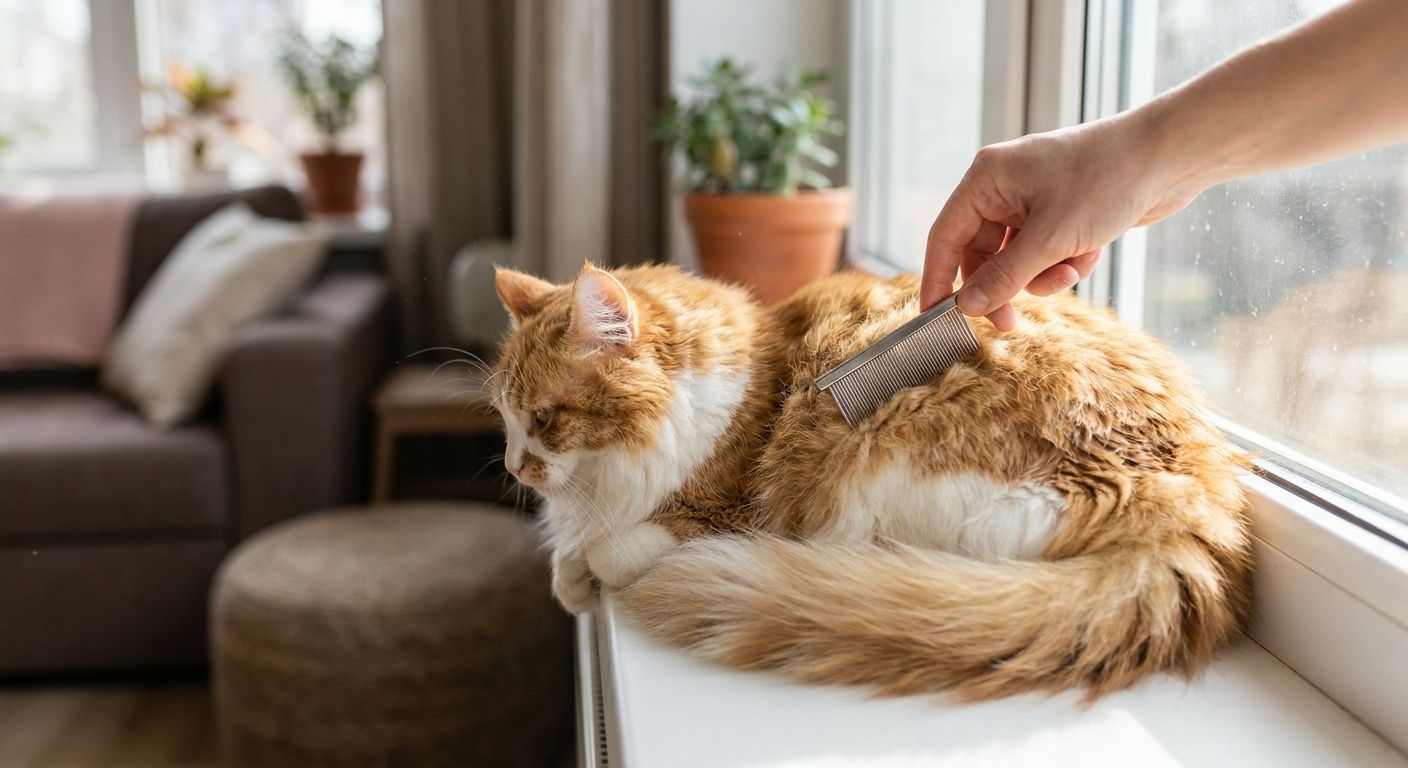
A flea comb works on long-haired cats once mats and tangles are cleared out first — the comb's teeth can't pass through matted fur to catch fleas or flea dirt. On a coat that's properly worked through, section by section, a flea comb catches adult fleas and flea dirt in long hair just as reliably as it does in short hair, but the session takes longer because there's more fur to move through.
- A flea comb is effective on long-haired cats only after mats and tangles are removed first.
- Matted fur blocks the comb's teeth, so a neglected long coat cuts effectiveness fast.
- Combing a long-haired cat takes longer because fur has to be worked through in layers, not one pass.
- Weekly combing catches new fleas early and keeps flea dirt from building up in a dense undercoat.
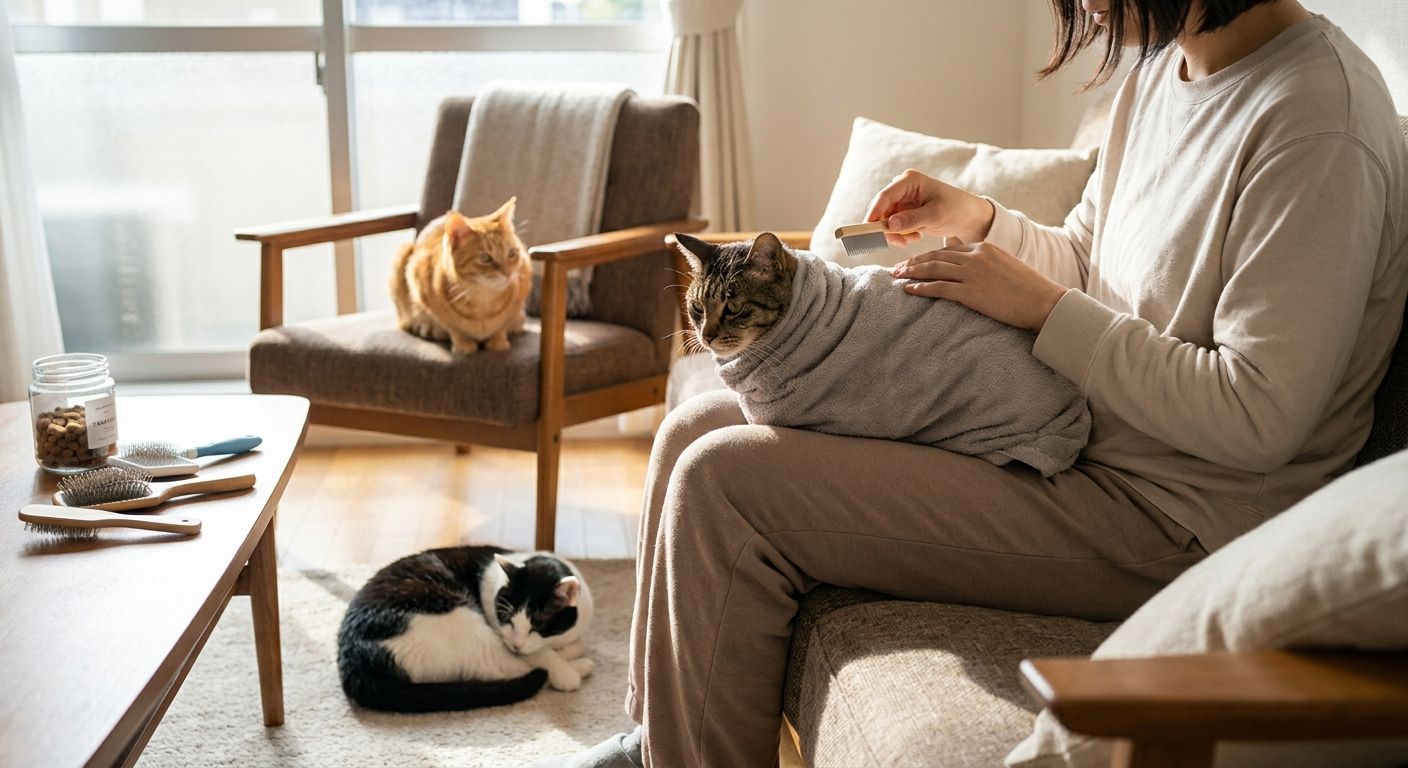
- A calmer hold during combing, like a wrap around the body, keeps a fidgety long-haired cat still enough to finish the pass.
Why this matters
Long-haired cats hide fleas better than short-haired cats do. Flea dirt (the small dark specks that are actually digested blood) sits low against the skin, under layers of guard hair and undercoat, so a quick visual check misses it almost every time.
A flea comb is still the fastest way to confirm an infestation before you commit to any treatment. Skipping it and jumping straight to a spot-on or shampoo means treating blind — you won't know if it worked, or if there was ever a flea problem to begin with. Pairing a flea comb with a proper cat grooming kit for long-haired cats makes the check-and-comb routine part of a normal grooming session instead of a separate chore.
Is a flea comb effective on long-haired cats?
Yes, with one condition: the coat has to be detangled first. A flea comb's teeth are spaced tight enough to trap fleas and flea dirt as they pass through fur, but that same tight spacing means the comb stops dead the moment it hits a mat. On a long-haired cat with an unbrushed undercoat, most of the comb's pull goes into fighting the tangle, not catching fleas.
Here's how a flea comb stacks up against the other tools people reach for on long-haired cats in 2026:
| Tool | Best for | Limitation | Verdict |
|---|---|---|---|
| Flea comb | Confirming fleas/flea dirt, spot-checking after treatment | Slow on matted or very dense undercoats | Buy |
| Grooming glove | Loosening loose fur and light debris during petting | Doesn't reach flea dirt against the skin | Hold |
| Slicker brush | Detangling before a flea comb pass | Not designed to catch fleas at all | Skip (for flea checks) |
| Spot-on/oral flea treatment | Ongoing prevention, active infestations | Doesn't tell you whether fleas are actually present | Buy (alongside combing) |
Grooming gloves are useful for keeping a long coat manageable between sessions, and a grooming glove built for long-haired cats speeds up the detangling step that has to happen before a flea comb can do its job. Neither tool replaces the other — the glove clears the path, the comb does the flea check.
Why flea comb effectiveness varies on long-haired cats
Effectiveness isn't fixed. It moves depending on a handful of things you control and a few you don't:
- Coat density. A cat with a thick double coat (Maine Coon, Ragdoll, Persian) holds more fur between skin and comb, so each pass covers less ground.
- Matting. Even light matting near the armpits, belly, or behind the ears blocks the comb before it reaches skin.
- Comb tooth spacing. Tighter-spaced teeth catch smaller debris but clog faster in dense fur; wider teeth glide but miss more.
- Session length. A rushed 30-second pass skips the low-lying fur where flea dirt actually sits.
- How often it's done. A single comb-through tells you what's there today. Weekly combing tells you whether a treatment is working.
- The cat's tolerance. A cat that squirms halfway through the belly section leaves the highest-risk area unchecked — which is exactly where flea dirt tends to collect.
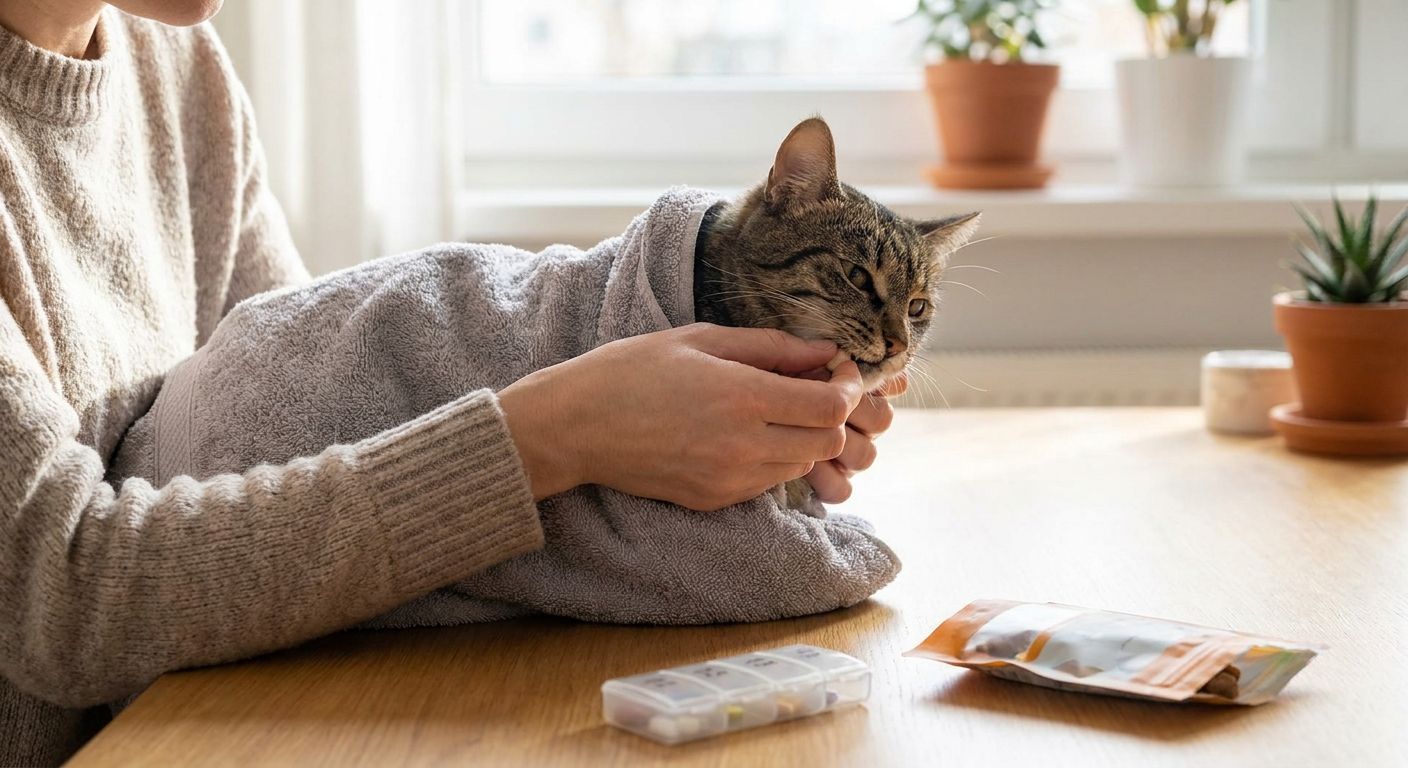
That last point is the one most pawrents underestimate. A flea comb only catches what it actually touches, and a cat that won't sit still for the belly and hind legs means those zones never get checked. Some cat parents use a wrap-style hold, snugly, not tightly, to keep the body still while the comb works through the harder-to-reach spots without turning the session into a wrestling match.
“A flea comb only catches what it touches, and on a matted coat, that's mostly the mat.”
Combing regularly also does more than catch fleas. It pulls out loose undercoat before the cat swallows it, and regular grooming can reduce hairballs at the same time it's checking for fleas — one session, two problems solved.
How often should you flea comb a long-haired cat?
Weekly combing catches a new infestation early, before flea dirt builds up under a dense undercoat. If a cat is already on a flea treatment, a weekly comb-through in 2026 is the simplest way to confirm the treatment is actually working rather than guessing based on scratching behavior alone.
Can a flea comb remove flea eggs, not just adult fleas?
A flea comb can pull flea eggs and flea dirt out of the coat, since both sit loose in the fur rather than attached to skin. It won't reach eggs already laid in bedding, carpet, or furniture — that part of the flea life cycle needs environmental treatment, not combing.
Do long-haired cats need a different comb than short-haired cats?
Long-haired cats generally do better with a comb that has a slightly wider first row of teeth to break through the outer coat, followed by finer teeth to reach the undercoat. A single fine-tooth comb works, but it clogs faster on long hair and needs more frequent cleaning between passes.
A young cat still learning to accept handling adds its own variable — how long it will sit still. If combing sessions keep ending early, it's worth looking at how long it takes to desensitize a cat to grooming before assuming the comb itself is the problem.
One last thing
The quickest way to tell flea dirt from ordinary dirt: comb a small amount onto a damp white paper towel. Regular dirt stays dark or grey. Flea dirt turns reddish-brown as it rehydrates, because it's digested blood. That five-second test settles the debate faster than staring at the comb trying to guess.
FAQ
Is a flea comb effective on long-haired cats?
A flea comb is effective on long-haired cats once mats and tangles are removed first, since matted fur blocks the comb's teeth before they reach skin. On a properly detangled coat, it catches fleas and flea dirt just as well as it does on short-haired cats.
How often should you flea comb a long-haired cat?
Weekly flea combing is enough for most long-haired cats to catch a new infestation early. Cats already on a flea treatment benefit from the same weekly pass to confirm the treatment is working.
Can a flea comb remove flea eggs?
A flea comb removes loose flea eggs and flea dirt from the coat, since neither is attached to the skin. It cannot remove eggs already laid in bedding or carpet, which need separate environmental treatment.
Does matting stop a flea comb from working?
Matting stops a flea comb almost completely, because the comb's teeth catch on the tangle instead of passing through to skin. Detangling with a slicker brush or grooming glove before combing solves this.
Is a flea comb better than a spot-on treatment for long-haired cats?
A flea comb and a spot-on treatment do different jobs: the comb confirms whether fleas are present, and the treatment kills or prevents them. Long-haired cats generally need both, not one instead of the other.
What comb spacing works best on long-haired cats?
A comb with wider teeth up front to break through the outer coat, followed by finer teeth for the undercoat, generally works better on long hair than a single fine-tooth comb. A single fine-tooth comb still works but clogs faster and needs more frequent cleaning.
Why won't my long-haired cat sit still for flea combing?
Cats that squirm during combing often haven't been desensitized to handling around sensitive areas like the belly and legs, which is also where flea dirt tends to collect. Shorter, calmer sessions with a supportive hold usually improve tolerance over a few weeks.