Prying a cat's jaw open with one hand while it corkscrews out of your lap turns a two-second pill into a ten-minute chase, and it usually ends with a scratch down your forearm. Wrap your cat in a restraint wrap before you touch the pill bottle or syringe, and both your hands stay free to actually medicate instead of just holding on.
- The Snug Pro Cat Wrap is the fastest way to give cat pills alone in 2026 because it holds the body still and frees both hands.
- Fasten the wrap snugly across the shoulders and chest, leave the head clear, and pill in one motion.
- Liquid medication uses the same wrap with the head tilted back slightly instead of forward.
- Bath towels and two-person holds both fail the 'alone' test in 2026 kitchen tests - they slip or need a second set of hands.
Why this matters
Most pilling attempts fail not because the cat won't swallow, but because the cat won't stay still long enough for you to get the pill past the back of the tongue. A loose towel wrap loosens in under a minute. A one-handed scruff-and-pill move works for maybe one cat in five. If you're dosing twice a day for a course of antibiotics, that math wears you down fast, and it wears the cat down too - a struggling cat associates medication time with panic, which makes every future dose harder.
A restraint wrap changes the mechanics. The cat's body stays still, its front paws stay contained, and your dominant hand is free to work the pill or syringe instead of wrestling a limb. That's the entire problem solved in one piece of fabric.
Restraint options compared
| Method | Best for | Pros | Cons | Verdict |
|---|---|---|---|---|
| Bath towel wrap | Owners who already have a towel handy | Free, familiar, no purchase needed | Slips loose in under a minute, doesn't hold shape under struggle | Wait |
| Two-person hold | Calm cats with a helper available | Steady grip, fast for easy cats | Needs a second person - defeats the whole point of doing it alone | Skip if solo |
| Snug Pro Cat Wrap | Pills, liquids, or nail trims done solo | Fastens closed, frees both hands, reusable for every dose | Wrap-shy cats need a few practice sessions before medication day | Buy |
Before you start
- Measure and set out the exact dose - pill in a pill popper, or liquid drawn into the syringe - on the counter before the cat is anywhere near the wrap. Fumbling for the dose mid-hold undoes the whole point of freeing your hands.
- Pick a small, quiet room with the door closed and no visible carrier. Cats read the room before they read your intentions.
- The gotcha: if the wrap only ever appears at medication time, your cat will start bolting the second it sees the fabric, even weeks into a course. Leave the wrap out near your cat's resting spot for a few days beforehand so it isn't purely a bad-thing-happens-now signal by the time you actually need it in 2026's flu or UTI season.
Set up the wrap before the cat is anywhere near it
- Lay the Purrttie wrap flat and open on a table or counter at chest height, not on the floor. A raised surface means you're not bending over a squirming cat.
- Position your cat facing away from you or facing you, whichever your cat tolerates better - most cats settle faster facing away since they can't watch the pill approach.
- Draw the wrap around the shoulders and chest first, tucking the front paws in against the body. Snugly, not tightly - you should be able to slide two fingers under the fabric at the chest.
- Fasten the closure across the back or underside, leaving the head and neck completely free to move.
- Expected result: the cat can turn its head and meow, but can't get a front paw loose to bat away your hand.
Pill a cat alone once the wrap is on
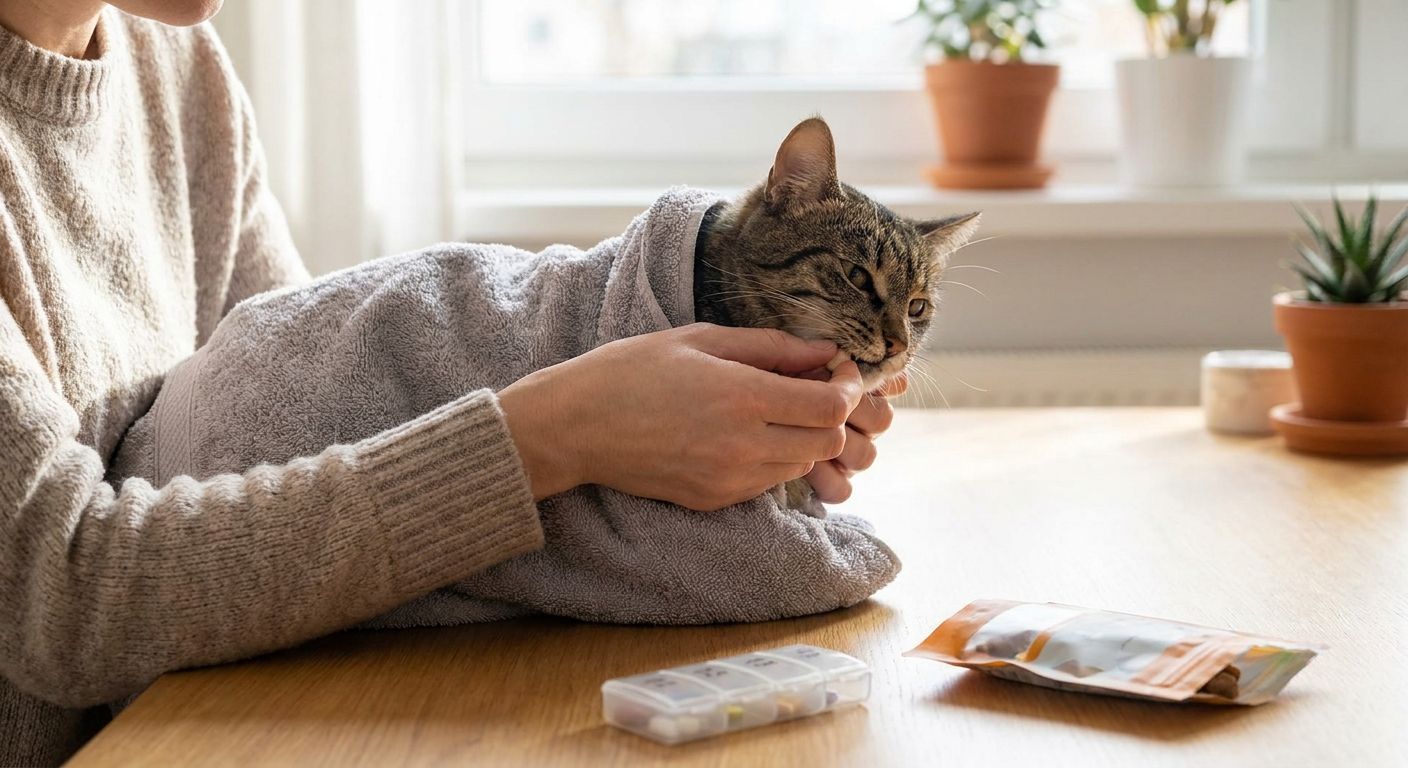
- With the wrap fastened, cradle the cat's head from above using your non-dominant hand - thumb and fingers along the cheekbones, not the throat.
- Tilt the head back gently until the nose points near the ceiling. This is the angle that opens the jaw naturally without forcing it.
- Use your dominant hand to press down lightly on the lower jaw with one finger while the pill sits ready between thumb and forefinger.
- Drop the pill (or use a pill popper) over the back of the tongue, past the bump at the center - not near the front teeth, where it gets spat back out.
- Close the mouth, keep the head tilted slightly up, and stroke the throat once or twice to trigger a swallow.
- Expected result: one visible swallow, followed by a lip lick. That's your confirmation the pill went down and not sideways into a cheek pocket.
Give liquid medication with the same wrap
The wrap setup doesn't change for liquids - only the head angle and delivery point do.
- Follow steps 1-4 above to get the cat wrapped and the head cradled.
- Tilt the head back slightly less than you would for a pill - a moderate angle, not straight up, so liquid doesn't pool at the back of the throat and trigger coughing.
- Insert the syringe tip into the side of the mouth, between the cheek and back teeth, not down the front.
- Depress the plunger slowly in small pushes, giving the cat time to swallow between pushes rather than dumping the full dose at once.
- Expected result: minimal dribble at the corner of the mouth and no coughing fit. A little drool is normal; a coughing spasm means you pushed the liquid too fast or aimed too far back.
Release the wrap and reward
- Unfasten the closure the moment the dose is confirmed swallowed - don't linger in the wrap once the job is done.
- Let the cat step out on its own terms rather than lifting it out.
- Offer a small reward immediately - a favorite treat, a few minutes of a preferred toy, or a calm ear scratch if that's the cat's currency.
- Expected result: the cat walks away rather than bolting under furniture. If it bolts every time, the wrap-to-reward gap is too slow - tighten it up next dose.
Troubleshooting
- A paw keeps working free mid-dose. The wrap is fastened too low, around the belly instead of across the chest and shoulders. Refasten higher, above the elbows.
- The cat spits the pill straight back out. You're aiming too far forward. The pill needs to clear the tongue's back bump, or it triggers a gag-and-spit reflex instead of a swallow.
- The cat panics before the wrap is even fastened. Stop and back off - this is a desensitization gap, not a technique problem. Spend a few sessions just draping the wrap loosely with treats before attempting a real dose; the desensitize a cat to grooming guide covers the pacing for that.
- The wrap slides down mid-dose. Tighten the shoulder fastening before your hands go anywhere near the mouth, not after the cat starts moving.
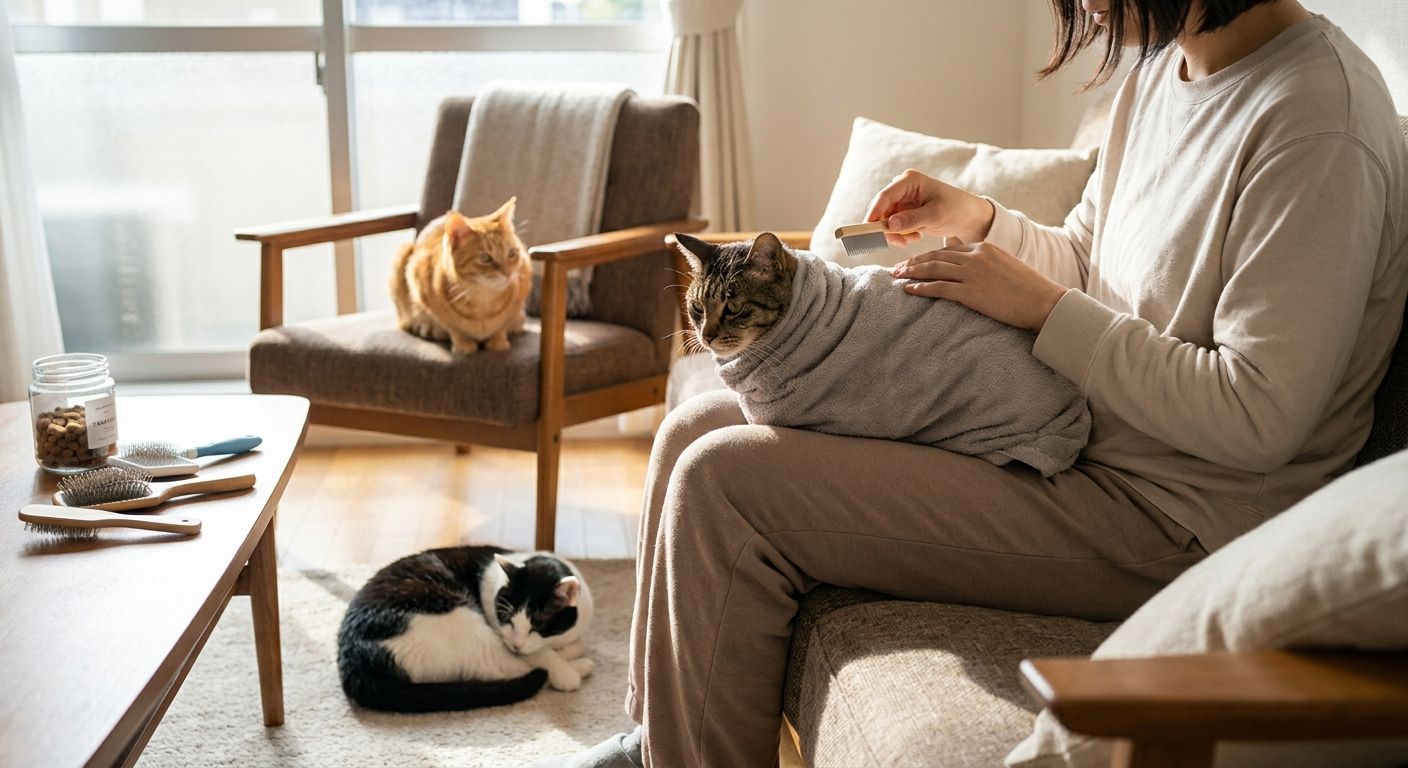
- The cat now bolts at the sight of the wrap on non-medication days. Unpair it from medicine entirely - use the same wrap for a brushing session or a nail trim so it isn't a one-note trigger.
Customize your workflow
Once solo pilling is reliable, the same wrap-and-restrain setup carries over to nail trims, ear cleaning, and eye drops - the head-cradle mechanics barely change between tasks. If you're dosing a cat with mobility issues or arthritis, the hold needs to be gentler and shorter; the at-home grooming safety guide for senior cats walks through how to adjust grip pressure and session length for older joints. For multi-cat households doing this daily, batching the wrap setup - measuring every cat's dose first, then wrapping and dosing one at a time - cuts total handling time in half compared to prepping between each cat.
FAQ
Can you really give a cat pills alone with a restraint wrap?
Yes - a restraint wrap holds the cat's body and front paws still, which frees both your hands for the pill instead of needing a second person to hold the cat. Most solo pilling failures come from the cat squirming free, not from the pill itself.
What's the best restraint wrap for medicating a cat in 2026?
The Snug Pro Cat Wrap is built specifically for medication, nail trims, and vet visits, with a fastening system that keeps the shoulders and chest contained while leaving the head free. A bath towel works in a pinch but loosens within a minute of struggling.
Is it better to pill a cat with the head tilted up or forward?
Tilt the head back so the nose points toward the ceiling, not forward or level. That angle opens the jaw naturally without forcing it and reduces the chance the cat spits the pill back out.
How do I stop my cat from spitting out pills?
Drop the pill past the bump at the back of the tongue, not near the front teeth. Close the mouth immediately after and stroke the throat once to trigger a visible swallow.
Do I need a second person to medicate my cat?
No, a restraint wrap replaces the second person by holding the body still on its own. Two-person holds work but they're not a solo solution, which defeats the point if you're often home alone.
How long does it take to get a cat used to a restraint wrap?
It varies by cat, but most cats tolerate a wrap faster when it's introduced during calm moments, not only at medication time. Leaving the wrap out near resting spots for a few days before the first real use speeds up acceptance.
Can the same wrap be used for liquid medication and pills?
Yes - the wrap setup is identical for both. Only the head angle changes: less tilt for liquids to avoid coughing, more tilt for pills to open the jaw fully.
What if my cat still panics inside the wrap?
Stop the dosing attempt and go back to short desensitization sessions with treats and no medication involved. Forcing a panicked cat through a dose makes every future attempt harder, not easier.
One last thing
The detail most pawrents skip is the reward timing, not the wrap technique. A cat that gets a treat within seconds of release learns "wrap, then good thing" faster than a cat that gets praised a minute later after wandering off - and that faster association is what turns a twice-daily antibiotic course from a wrestling match into a routine by day three or four.