Long-haired cats shed in two coat layers, and a flat brush alone often can't reach the undercoat without pulling. The right cat grooming glove closes that gap by combining bristle contact with the gentle, hands-on feel most cats already trust.
- Double-sided silicone bristle gloves are the best overall pick for long-haired cats in 2026 because they reach both coat layers in one pass.
- Fine mesh gloves work best on sensitive-skin cats prone to redness after brushing.
- Short-nub rubber gloves are the budget-friendly starting point for kittens or first-time groomers.
- Cats that fight every glove often do better with a body wrap plus a slicker brush instead.
Why this matters
A long-haired cat that isn't brushed 3 to 4 times a week during shedding season ends up with mats near the armpits and belly, and mats mean a trip to the vet for a shave-down. Grooming gloves solve the compliance problem before the coat problem, because most cats read a gloved hand as petting rather than a tool.
Purrttie builds calmer-handling tools for the moments gloves can't cover — nail trims, meds, vet visits — but doesn't manufacture grooming gloves itself. This guide ranks the glove types that actually work on long fur in 2026, and tells you honestly which cats are better served by a different tool entirely.
What makes the best cat grooming gloves
- Dual coat reach — short nubs for the top coat, longer bristles or a mesh weave for the undercoat
- Cuff fit — a snug wrist strap that won't slide off mid-session
- Fur release — fur that peels off in one sheet instead of clogging between bristles
- Material breathability — matters more in Malaysia, Singapore, and Thailand's humidity than in cooler climates
- Hand-size range — one-size gloves fit poorly on smaller hands and lose grip halfway through a session
- Washability — silicone rinses clean; fabric mesh needs air-drying between uses
Cat grooming gloves at a glance
| Type | Best for | Standout feature | Key limitation |
|---|---|---|---|
| Double-sided silicone bristle glove | Long-haired cats overall | Nubs on one side, longer bristles on the other | Bristles can clog on badly matted fur |
| Fine mesh fabric glove | Sensitive-skin cats | Soft weave, no rigid nubs | Less effective on thick undercoats |
| Adjustable wide-cuff silicone glove | Multi-person households | Strap fits a wider range of hand sizes | Bulkier fit for smaller hands |
| Short-nub rubber glove | Kittens and first-timers | Gentle, low-intensity contact | Doesn't reach the undercoat |
| Snug Pro Cat Wrap + slicker brush | Cats that fight gloves entirely | Keeps the body still while you brush the exposed head and paws | Not a full-body brushing solution on its own |
1. Double-sided silicone bristle glove: best cat grooming glove for long-haired cats overall
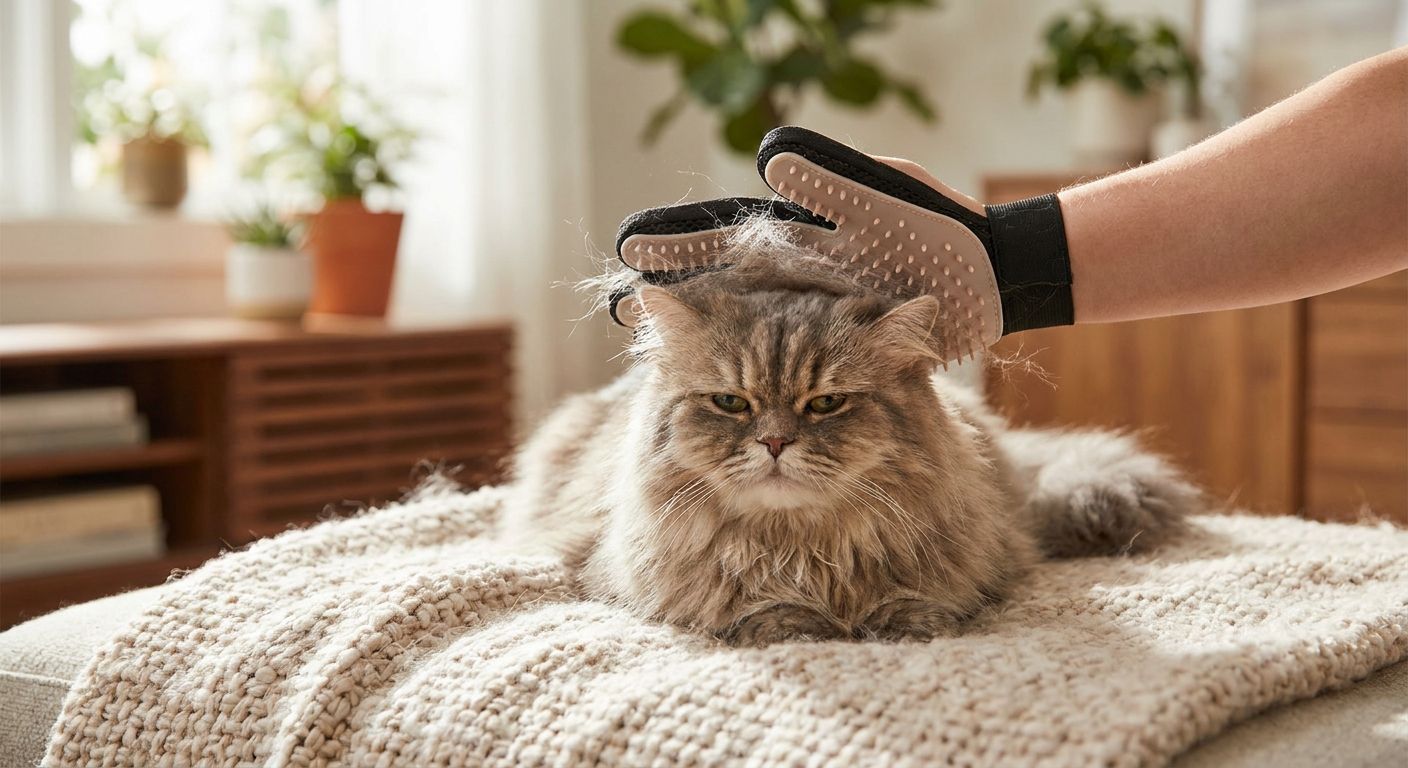
This is the type most long-haired-cat owners reach for first because it does two jobs in one pass — short nubs lift loose top-coat fur, and the longer bristle side works through the denser undercoat underneath. Fur collects on the glove surface and peels off in one sheet, which cuts a 5-minute session down from the usual back-and-forth with a slicker brush.
Double-sided silicone bristle glove pros:
- Covers both coat layers without switching tools
- Fur peels off in a single sheet for fast cleanup
- Doubles as a bonding tool since cats read it as petting
Double-sided silicone bristle glove cons:
- Bristles jam if the fur is already matted — detangle first with a comb
- Cheaper versions lose grip strength on the nubs after repeated washing
Best for: long-haired cats with a healthy, unmatted coat that just needs regular upkeep. Verdict: Buy — this is the default pick for 2026.
2. Fine mesh fabric glove: best cat grooming glove for sensitive-skin cats
Some long-haired breeds, and most senior cats, have thinner skin that reddens under rigid silicone nubs. A fine mesh or micro-terry glove keeps the same hand-shaped contact but drops the pressure point, which matters for a cat already dealing with dry or flaky skin. The gloves for sensitive-skin cats breakdown goes deeper into which weaves cause the least irritation.
Fine mesh fabric glove pros:
- Gentler on thin or reactive skin
- Doubles as a light polish for the top coat between full brushings
- Machine-washable in most cases
Fine mesh fabric glove cons:
- Barely touches the undercoat, so mats still form underneath
- Wears thin faster than silicone with daily use
Best for: cats with sensitive or reactive skin who still need daily coat contact. Verdict: Buy, but pair it with a separate undercoat tool once a week.
3. Adjustable wide-cuff silicone glove: best for multi-person households
In a household where more than one person handles grooming, a fixed one-size glove fits one hand well and everyone else's hand poorly. An adjustable wide-cuff version solves the fit problem across different hand sizes, which keeps the strap snug instead of sliding off mid-stroke.
Adjustable wide-cuff silicone glove pros:
- Works across a wider range of hand sizes in one household
- Strap stays put through a full session
- Same dual-coat bristle design as the standard silicone glove
Adjustable wide-cuff silicone glove cons:
- Bulkier profile than a fixed-size glove
- Adjustable strap is one more part that can wear out
Best for: households where two or more people share grooming duty. Verdict: Buy if fit has been an issue with a standard glove.
4. Short-nub rubber glove: best budget cat grooming glove for kittens
Kittens and cats new to grooming don't need the most aggressive tool on the shelf. A short-nub rubber glove applies light, low-intensity contact that introduces the sensation of grooming without overwhelming a cat that's never been brushed. It's also the lowest-cost entry point into gloved grooming in 2026.
Short-nub rubber glove pros:
- Gentle enough for a first grooming session
- Lower cost than dual-layer silicone gloves
- Easy to rinse clean
Short-nub rubber glove cons:
- Doesn't reach the undercoat on adult long-haired cats
- Cats will likely outgrow it once shedding season hits
Best for: kittens or any cat starting glove training for the first time. Verdict: Buy as a starter, then move up to a bristle glove.
5. Snug Pro Cat Wrap + slicker brush: best for cats that refuse gloves entirely
Not every cat tolerates a hand shape coming toward them, no matter how soft the material. For that cat, a glove isn't the fix — restraint during the exposed parts of the session is. The Snug Pro Cat Wrap holds the body snugly, not tightly, while you brush the head, ears, and paws that stay exposed, then work down as the cat relaxes into it.
Snug Pro Cat Wrap pros:
- Keeps a squirmy or anxious cat still for the parts a glove can't reach anyway
- Built for calmer nail trims, meds, and vet visits, not just grooming
- Lets the cat leave on their own terms once the wrap loosens
Snug Pro Cat Wrap cons:
- Not a substitute for full-body brushing on its own
- Needs two hands to set up, so it works better with a second person for a full coat session
Best for: cats that fight every glove and need to be settled before any brushing happens. Verdict: Buy as the backup plan, not the primary grooming tool.


How we ranked these
Each type was measured against the six criteria above — dual coat reach, cuff fit, fur release, breathability, hand-size range, and washability — with long-haired coats as the baseline, since a glove that works fine on a short-haired cat can fail entirely once it hits a Maine Coon's undercoat.
“A matted long-haired cat isn't a grooming problem anymore, it's a detangling problem — solve that first before any glove goes near the coat.”
Which cat grooming glove should you choose in 2026?
Default to the double-sided silicone bristle glove if your long-haired cat already tolerates brushing and just needs a faster, gentler tool. Switch to a fine mesh glove if the skin underneath reacts to nubs, and start kittens on a short-nub rubber glove before they graduate to anything stronger. If your cat won't let a gloved hand near them at all, stop fighting the glove and settle the cat first — that's what the Snug Pro Cat Wrap is built for.
FAQ
What's the best cat grooming glove for long-haired cats in 2026?
A double-sided silicone bristle glove is the best overall pick for long-haired cats in 2026 because it reaches both the top coat and undercoat in one pass. Cats with sensitive skin do better with a fine mesh version instead.
Are grooming gloves better than brushes for long-haired cats?
Grooming gloves work better for cats that tolerate hands but resist tools, since the glove feels like petting rather than brushing. A slicker brush still removes more undercoat on heavily matted fur than any glove can.
How often should I use a grooming glove on a long-haired cat?
Long-haired cats typically need brushing 3 to 4 times a week during shedding season, and 1 to 2 times a week outside of it. A daily 5-minute glove session prevents most mats before they start.
Do grooming gloves work on matted fur?
Grooming gloves struggle on established mats because bristles catch and pull instead of gliding through. Detangle mats with a comb first, then use the glove for regular maintenance afterward.
What if my cat won't tolerate a grooming glove at all?
Some cats read any hand-shaped object coming at them as a threat, no matter the material. A body wrap that holds the cat snugly while you brush the exposed head and paws often works better than forcing a glove.
Are silicone or fabric gloves better for sensitive-skin cats?
Fine mesh fabric gloves are gentler on sensitive or reactive skin than rigid silicone nubs. They don't reach the undercoat as well, so pair one with a separate detangling tool once a week.
Can kittens use cat grooming gloves?
Kittens do best with a short-nub rubber glove that applies light, low-intensity contact rather than a dual-layer bristle design. It introduces grooming without overwhelming a cat that's never been brushed before.
How do I clean a cat grooming glove?
Silicone gloves rinse clean under running water in seconds. Fabric mesh gloves usually need a gentle hand wash and full air-dry before the next use.
One last thing
The glove that removes the most fur per stroke isn't always the one that gets used — the one that takes 5 minutes and doesn't require chasing the cat around the room wins by default. Match the glove to how your cat actually behaves during grooming, not to which one looks the most capable on the shelf.