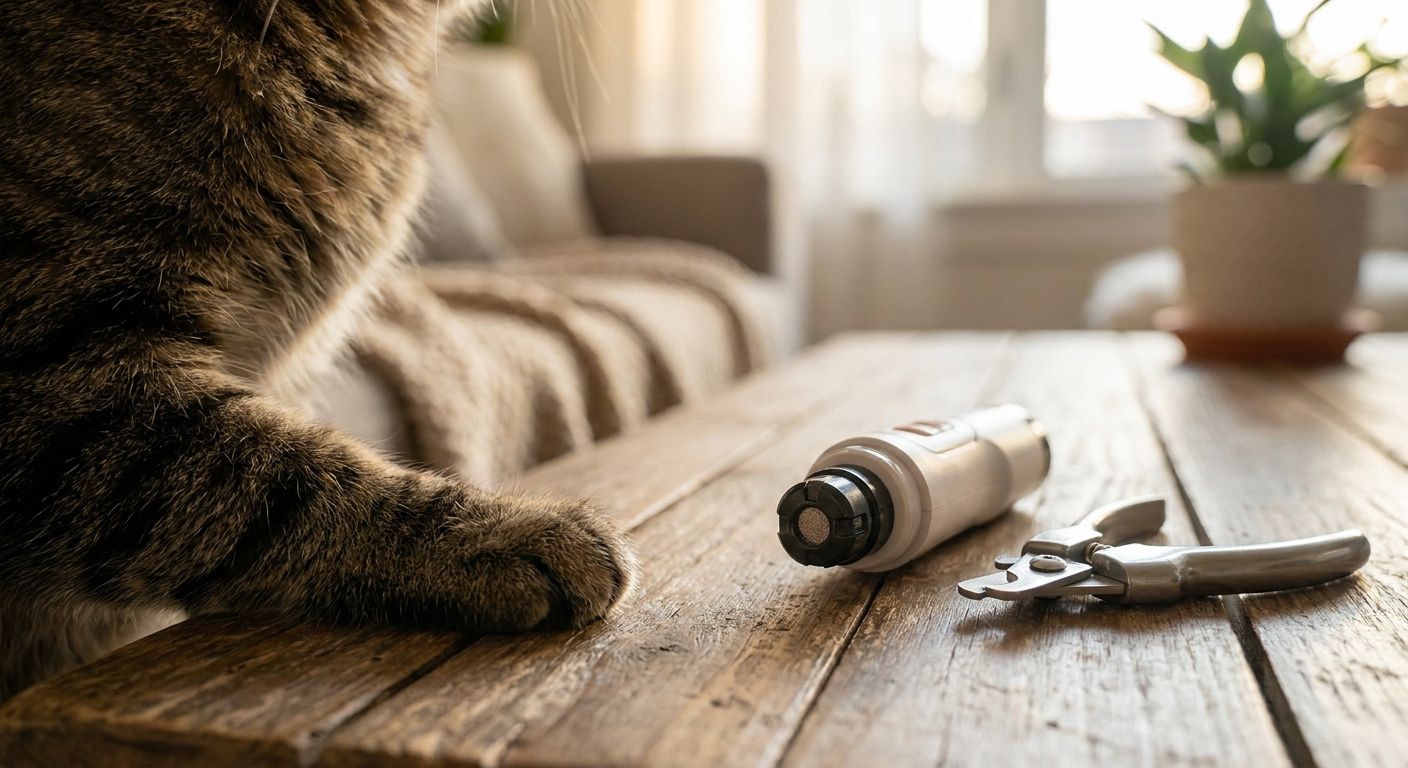
A cat nail grinder isn't better than clippers across the board — it's better for a specific type of cat, and clippers win for most first-time trims in 2026. Grinders sand the nail down gradually, which rounds the tip and avoids the sharp edge a clipper can leave, but the motor's noise and vibration make them harder to introduce to a nervous cat. Clippers finish a full set of claws in under two minutes once your cat tolerates the process, with none of the buzzing that sends some cats bolting under the sofa. The real trade-off isn't precision — both tools cut nails safely when used correctly — it's which sensory experience your specific cat can handle.
- Whether a cat nail grinder is better than clippers depends on your cat's tolerance for noise and vibration, not on which tool trims faster.
- Cat nail clippers finish a full trim in under two minutes once a cat is desensitized; grinders take longer per nail.
- Grinders round the nail edge and reduce snagging, but the motor sound puts off many cats during 2026 grooming sessions.
- Both tools risk nicking the quick if you skip slow introduction and proper handling.
Why this matters
Most cat parents pick a tool based on what a groomer or a friend uses, then wonder why their cat won't sit still for it. A grinder that works beautifully on a calm, handled cat can turn a five-minute trim into a wrestling match with a cat who's never heard a motor near their paws. The best cat nail grinders compared side by side still won't fix a mismatch between the tool and your cat's temperament — that's a handling problem, not a product problem.
Getting this choice right up front saves you weeks of stressed trims and a cat who associates grooming with a fight. In 2026, both grinders and clippers are widely available, but they solve different problems.
Is a cat nail grinder better than clippers?
Here's how the two tools compare on the factors that actually decide a trim's success:
| Feature | Cat Nail Grinder | Cat Nail Clippers |
|---|---|---|
| Noise level | Motor hum, audible to cats before you hear it | Silent until the snip |
| Speed per nail | Several seconds of contact per nail | One motion, instant |
| Edge finish | Rounded, smooth edge | Flat cut, can leave a sharp point |
| Best for | Cats already desensitized to vibration and sound | First-time trims, noise-sensitive cats |
| Learning curve | Steeper — cat must tolerate contact time | Shorter — one quick motion per nail |
| Risk of quick nick | Lower if used slowly, since you can stop mid-grind | Higher if you guess the cut line wrong |
Verdict: clippers are the safer starting tool for most cats in 2026, and grinders are a smoothing step you add once your cat already tolerates handling.
Cat nail grinders: best for gradual, edge-smoothing trims
A grinder removes tiny amounts of nail at a time, which is useful for cats with thick or curved nails where a clipper's single cut risks splitting the nail. The trade-off is contact time — you're holding a paw steady against a spinning bit for several seconds per nail, not one quick squeeze. Best for: cats already comfortable with paw handling and mechanical sound. Skip it for a cat who flinches at a hair dryer or vacuum, since the vibration reads the same to them.
Cat nail clippers: best for fast, quiet trims
Clippers do the job in one motion and make no sound until the cut itself, which matters more than most pawrents expect — a lot of cat stress during grooming comes from anticipation, not the cut. A well-designed clipper with a wide viewing angle on the blade also makes it easier to see the quick before you cut, cutting down on nicks. The Full Stainless Steel Cat Nail Clipper is built from a single piece of steel with an 18mm wide-view blade specifically so you can see the quick clearly instead of guessing. Best for: first-time trims, anxious cats, and pawrents who want the session over quickly. Watch for: the cut edge can feel sharp to the cat afterward if you don't file it down.
If your cat is genuinely anxious about any tool near their paws, the trim tool matters less than the handling method. Cats with a history of struggling during nail care are often better served by the best cat nail clippers for anxious cats paired with a wrap that limits movement rather than a quieter grinder — the wrap addresses the actual source of the stress.
Why the right choice varies
The grinder-versus-clippers decision comes down to a handful of factors specific to your cat, not a universal ranking:
- Noise sensitivity — cats who bolt at vacuum cleaners or hair dryers rarely tolerate a grinder's motor
- Nail thickness and shape — thick or curved nails are more prone to splitting under a clipper's single cut
- How desensitized your cat already is — desensitization to grooming is a gradual process, and starting with the more tolerable tool speeds it up
- Your own dexterity and confidence — a shaky hand with a clipper is riskier than a steady hand with a grinder, or the reverse
- Frequency of trims — cats trimmed every 2-3 weeks tolerate either tool better than cats trimmed only when nails get dangerously long
- Whether your cat needs restraint during the trim — a wrap or towel can make either tool viable on a cat that would otherwise struggle
For cats who need to be held still regardless of which tool you use, the Snug Pro Cat Wrap keeps a cat gently secured so paws stay accessible without a full-body chase — useful whether you're introducing a grinder for the first time or doing a routine clipper trim.


Do vets recommend nail grinders or clippers for cats?
Most vets recommend whichever tool the cat tolerates without escalating stress, since a fought-through trim does more harm than the tool choice itself. Clippers are usually the first tool suggested for new cat parents in 2026 because they require less contact time and are easier to use correctly on the first attempt. Grinders come up more often for cats with thick, brittle, or curved nails where a clean single cut is harder to achieve.
Can I switch from clippers to a grinder later?
Yes, switching from clippers to a grinder later works well once your cat is fully comfortable with paw handling and short bursts of vibration near their feet. Introduce the grinder slowly and unpowered at first, letting your cat sniff and touch it before it's ever turned on near a paw. Rushing the introduction is the most common reason a switch fails.
How often should I trim a cat's nails with a clipper or grinder?
Most indoor cats need a nail trim every 2 to 3 weeks regardless of which tool you use, since indoor cats don't wear nails down naturally the way outdoor cats do. Senior cats and kittens sometimes need more frequent checks since their nails grow at different rates and can curl into the paw pad if left too long.
FAQ
Is a cat nail grinder better than clippers for a first-time trim?
Clippers are generally better for a first-time trim because they finish in one motion with no motor noise to introduce. Grinders work well later, once your cat already tolerates handling and vibration.
Do cat nail grinders hurt cats?
A cat nail grinder doesn't hurt a cat when used correctly and kept away from the quick, but the vibration and sound can cause stress in cats not used to it. Slow introduction reduces this significantly.
Are cat nail clippers safer than grinders?
Neither tool is inherently safer; clippers risk a sudden nick if you misjudge the cut line, while grinders risk overheating a nail if held too long in one spot. Both are safe with a steady hand and good lighting.
What's the quietest way to trim a cat's nails?
Cat nail clippers are the quietest option since there's no motor running before the cut itself. This matters most for cats already sensitive to household noise like vacuums or hair dryers.
Can I use a human nail clipper on a cat?
Human nail clippers aren't shaped for a cat's curved nail and increase the risk of splitting or crushing it. A cat-specific clipper with a wide viewing blade gives a cleaner, safer cut.
Do grinders work on thick or overgrown cat nails?
Grinders handle thick or overgrown nails well since they remove material gradually instead of cutting through in one motion. This lowers the chance of splitting compared to a single clipper cut on a very thick nail.
How do I calm a cat down before a nail trim?
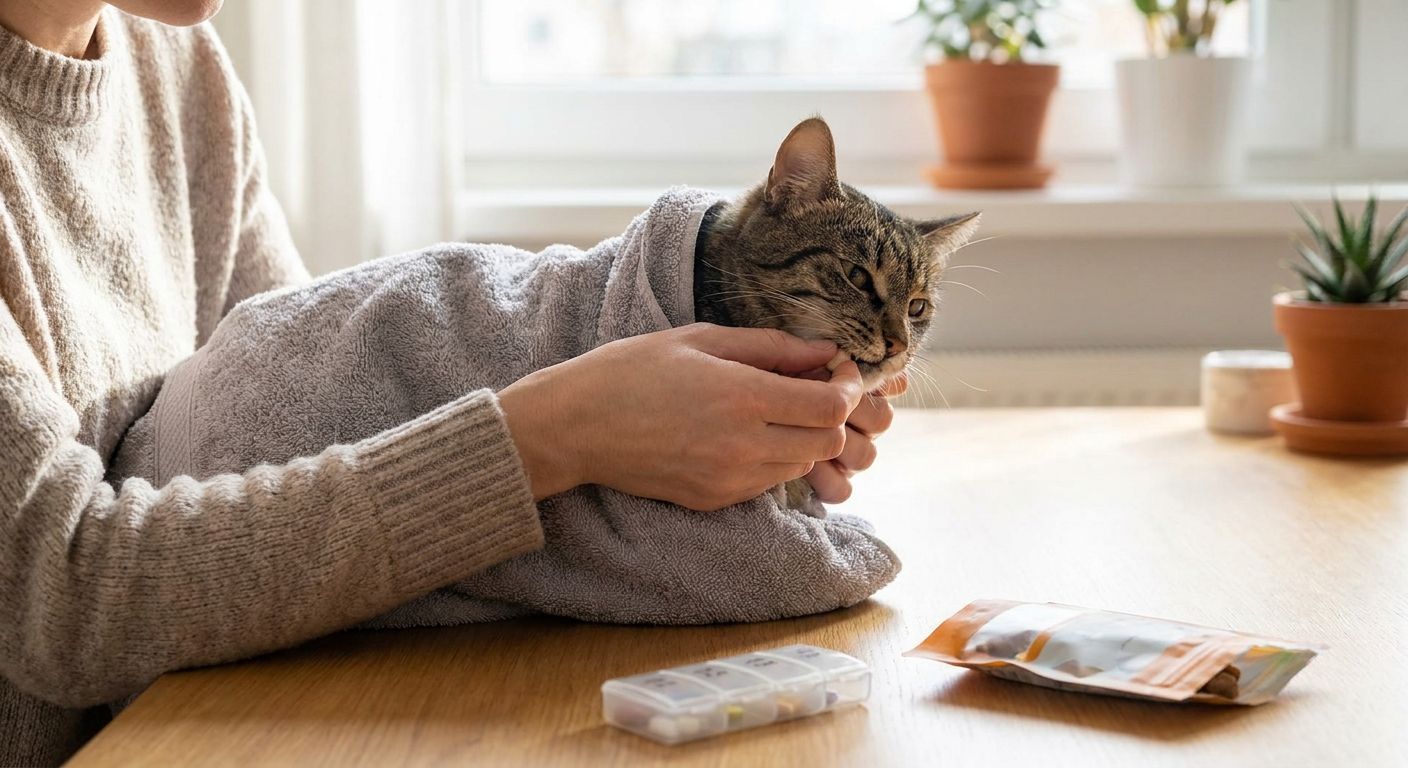
Gentle physical restraint, a calm environment, and short handling sessions before the actual trim all help calm a cat down. A wrap or towel that limits movement without pressure works better than trying to hold a cat down by hand.
One last thing
A cat's hearing range extends up to roughly 64,000 Hz, well beyond human hearing — which means a grinder that sounds like a gentle hum to you can register as sharp and intrusive to your cat. That's the real reason grinders take longer to introduce than clippers: it's not the sensation on the paw, it's the sound arriving well before the tool ever touches them. Start any grinder introduction powered off, in a quiet room, days before the first actual trim.