Indoor cats don't wear their claws down on tree bark or pavement, so nail length becomes a job you have to manage yourself. The question for 2026 isn't just "which nail caps are best" — it's whether nail caps are even the right tool for your indoor cat, versus trimming, grinding, or letting a groomer handle it. This guide ranks all five real options by stress level, upkeep, and safety so you can pick the one that actually fits your cat.
- Vinyl nail caps blunt claws for roughly 4-6 weeks and suit indoor cats that shred furniture; they don't stop the scratching instinct itself.
- Purrttie's Snug Pro Cat Wrap paired with a stainless steel clipper is the best overall setup for anxious or wriggly indoor cats in 2026.
- Nail grinders round claw edges but run longer and louder than a clip-and-cap routine, which most cats tolerate less.
- Professional groomer-applied caps suit pawrents who want zero DIY, though the appointment repeats roughly every month.
Best overall for indoor cats: trimming with a calming wrap. Best for furniture protection without changing scratching behavior: vinyl nail caps. Best long-term, lowest-upkeep option: a stainless steel clipper used on its own.
Why this matters
An indoor cat's claws keep growing whether or not there's a scratching post nearby, and overgrown nails on senior cats can curl inward and grow into the paw pad. Younger cats without outdoor surfaces to file claws naturally tend to take that energy out on sofas, curtains, and door frames instead. Across households in Malaysia, Singapore, Thailand and Australia, that's the single biggest reason pawrents start searching for nail caps in the first place.
The right fix depends less on the product and more on your cat's temperament. A calm, cooperative cat handles a trim in under a minute. A wriggly or anxious one needs restraint that doesn't feel like a fight — which is where a wrap or a groomer visit changes the outcome more than the tool itself.
A first useful move: check what's already worked for other pawrents managing nail clippers ranked by safety features before committing to caps at all, since safety issues (quick-cutting, slipping, biting near the paw) come up more often with rushed trims than with the tool choice itself.
What makes the best nail solution for indoor cats
- Claw coverage duration — how long the fix lasts before you have to repeat it
- Handling stress level — how much restraint or cooperation the cat needs to sit still
- Reapplication and upkeep effort — glue, filing, or scheduling required to keep it working
- Fit safety — risk of nicking the quick, pinching skin, or applying caps too tight
- Suitability for anxious or senior cats — whether the method works on cats that resist handling
- Tool or appointment dependency — DIY at home versus needing a professional
At a glance: nail cap alternatives for indoor cats in 2026
| Option | Best for | Standout feature | Key limitation |
|---|---|---|---|
| Vinyl nail caps | Furniture protection without full trimming | Blunts claws for weeks at a time | Doesn't change scratching behavior itself |
| Stainless steel clipper (trim only) | Permanent, no-reapplication upkeep | One clean cut, no gluing or refitting | Needs a cooperative cat every 2-3 weeks |
| Snug Pro Cat Wrap + trim combo | Anxious or wriggly indoor cats | Keeps the cat snug without full restraint | Two tools to manage instead of one |
| Nail grinder | Cats that tolerate longer sessions | Rounds edges instead of a hard cut | Louder and slower than clipping |
| Professional groomer application | Pawrents who want zero DIY | Fitted by someone trained in application | Recurring appointments, not instant |
1. Vinyl nail caps: best for indoor cats that scratch furniture
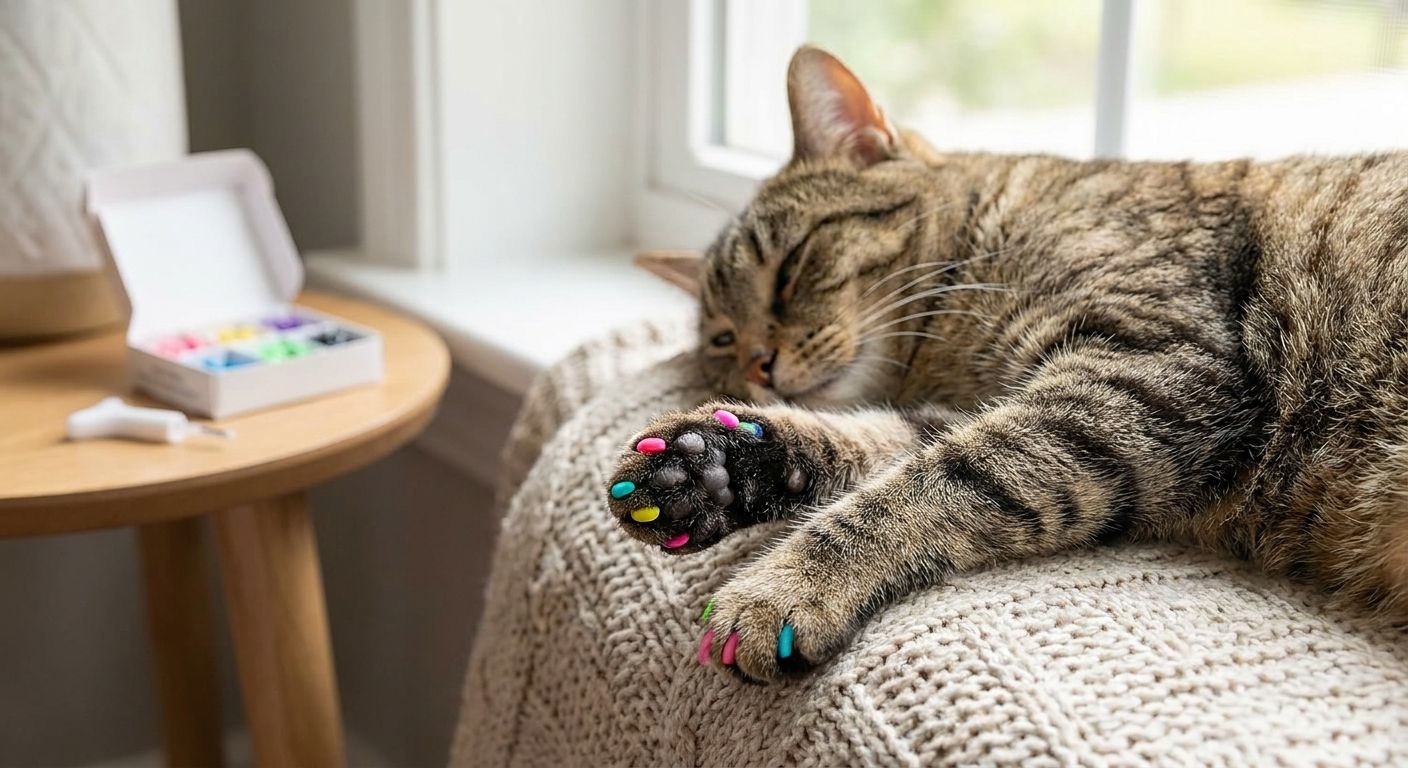
Vinyl nail caps are lightweight covers glued over a trimmed claw. They blunt the tip so scratching doesn't shred fabric, and they typically wear off naturally over 4-6 weeks as the claw grows and sheds its outer sheath, taking the cap along with it.
Vinyl nail caps pros:
- Protects furniture and skin from scratches without permanent claw removal
- No sharp edge left exposed between applications
- Comes in sizes matched to cat weight, from kitten to large breed
Vinyl nail caps cons:
- Requires a full nail trim first, so it doesn't remove the trimming step, it adds to it
- Some cats chew or pick caps off within days, especially anxious ones
- Doesn't address why the cat is scratching in the first place
Verdict: Buy if your main problem is furniture damage and your cat already tolerates a trim. Skip if your cat fights every handling session, since caps need the same restraint as a trim plus gluing time.
2. Full Stainless Steel Cat Nail Clipper: best for permanent, no-reapplication upkeep
A one-piece stainless steel clipper with a wide-view blade gives one clean cut instead of the split or crush you get from worn scissor-style clippers. Used alone on a 2-3 week cycle, it removes the sharp tip entirely rather than covering it.
Full Stainless Steel Cat Nail Clipper pros:
- No gluing, sizing, or refitting between sessions
- One-piece steel body means the blade doesn't loosen over time like hinged clippers
- Works on every claw stage, not just after a fresh trim like caps require
Full Stainless Steel Cat Nail Clipper cons:
- Needs a cat that will sit still, even briefly, every 2-3 weeks
- Doesn't prevent scratching between trims like a cap does
- Cutting too close to the quick is still possible without care
Verdict: Buy for pawrents who want the lowest ongoing upkeep and don't mind handling the paw directly. See how it stacks up against stainless steel cat nail clippers built the same way.
3. Snug Pro Cat Wrap + trim combo: best for anxious indoor cats
This pairing swaps restraint-by-force for restraint-by-wrap. Purrttie's Snug Pro Cat Wrap keeps the cat snugly, not tightly, held during a trim, medication, or vet prep, which lowers the stress a nervous cat brings into a nail session before the clipper even comes out.
Snug Pro Cat Wrap + trim combo pros:
- Reduces the chase-and-grab struggle that makes trims stressful for both cat and pawrent
- Lets the cat leave the wrap on their own terms once the trim is done
- Doubles as prep for medication or vet visits, not just nail care
Snug Pro Cat Wrap + trim combo cons:
- Two tools to buy and keep on hand instead of one
- Still requires the pawrent to complete the actual trim afterward
- Not a substitute for training a cat to tolerate handling long-term
Verdict: Buy for households with an anxious or hard-to-handle indoor cat where a standard trim turns into a wrestling match. This is the setup most pawrents in Malaysia, Singapore, Thailand and Australia land on once plain trimming has failed once or twice.
4. Nail grinder: best for cats that tolerate longer handling sessions
A grinder files the claw tip down instead of cutting it, which rounds the edge and avoids a hard clip line. It takes longer per claw than a clipper and runs with a vibration and hum most cats notice immediately.
Nail grinder pros:
- Rounds the edge smoothly, useful for cats prone to snagging claws on fabric
- No sharp cut line to catch on carpet or bedding
- Adjustable depth reduces risk of hitting the quick in one motion
Nail grinder cons:
- Noise and vibration make it harder on already-nervous cats
- Each claw takes longer than a single clip, extending the handling time
- Overheating the nail is possible if held in one spot too long
Verdict: Hold unless your cat is already comfortable with a longer, noisier handling session — for most indoor cats a quick clip is the easier win.
5. Professional groomer application: best for zero-DIY pawrents
A groomer fits and applies nail caps in-session, handling both the trim and the cap sizing in one visit. This removes the DIY step entirely but ties you to a recurring schedule roughly every month as caps wear off.
Professional groomer application pros:
- No learning curve for the pawrent, someone trained handles application
- Reduces risk of a poorly fitted cap coming loose early
- Useful backup if your cat won't tolerate any at-home handling at all
Professional groomer application cons:
- Requires scheduling and travel, not an instant fix
- Claws can grow long between visits if scheduling slips
- Costs recur every cycle with no reduction over time
Verdict: Wait on this as a first option — try at-home trimming or a wrap combo first, and fall back to a groomer only if handling truly isn't possible at home.


How we ranked these
Each option was measured against the same six criteria: coverage duration, handling stress, upkeep effort, fit safety, suitability for anxious or senior cats, and dependency on a tool versus an appointment. Vinyl caps score high on coverage but low on upkeep since they need refitting every 4-6 weeks. The wrap-and-trim combo scores highest on handling stress for difficult cats, which is why it takes the overall pick for 2026.
Which option should you choose?
If your cat sits reasonably still for a trim, the stainless steel clipper alone is the simplest long-term fix — no gluing, no reapplication, no appointments. If your cat fights handling or gets visibly anxious, the Snug Pro Cat Wrap paired with a clipper solves the actual problem, which is restraint, not the cutting tool. Reach for vinyl nail caps only when furniture protection is the priority and your cat already tolerates the trim caps require anyway. Save the groomer route for cats where none of the at-home options are realistic.
FAQ
What are the best cat nail caps for indoor cats in 2026?
Vinyl nail caps work best for indoor cats that scratch furniture, lasting roughly 4-6 weeks before they wear off naturally. For anxious cats, a trim paired with a calming wrap solves the underlying handling problem better than caps alone.
How long do vinyl nail caps last on a cat's claws?
Vinyl nail caps typically last 4-6 weeks as the claw grows and sheds its outer sheath. Active cats or heavy scratchers may lose caps sooner if they chew or pick at them.
Are nail caps safe for indoor cats?
Nail caps are generally safe when sized and applied correctly after a proper trim. The main risk is applying a cap too tight or skipping the trim step, which can pinch the claw or trap moisture underneath.
Is nail trimming better than nail caps for indoor cats?
Trimming alone is lower-upkeep long-term since there's no gluing or refitting involved. Nail caps add a layer of furniture protection on top of trimming but don't replace the trim itself.
Can I put nail caps on an anxious or wriggly cat?
You can, but the trim and gluing steps both require the cat to stay still, which is the hardest part for anxious cats. A calming wrap during the trim step makes the whole process easier before caps go on.
How often should indoor cats get their nails trimmed?
Most indoor cats need a trim every 2-3 weeks, though senior cats and kittens sometimes need more frequent checks. Nails that curl or click on hard floors are the clearest sign a trim is overdue.
Do nail caps stop cats from scratching furniture?
Nail caps blunt the claw so scratching does less damage, but they don't stop the scratching behavior itself. A scratching post alongside caps addresses both the behavior and the damage.
Are nail caps safe for senior cats?
Senior cats can wear nail caps, but thicker or brittle senior claws sometimes need a gentler trim first to avoid splitting before the cap goes on. Check with a vet if a senior cat's claws look unusually thick or curled.
One last thing
The detail most pawrents miss: nail caps only work as well as the trim underneath them. A cap glued over an un-trimmed or unevenly cut claw sits crooked, loosens faster, and falls off well before the usual 4-6 week mark — so the real upgrade in 2026 isn't a better cap, it's a cleaner cut underneath it.