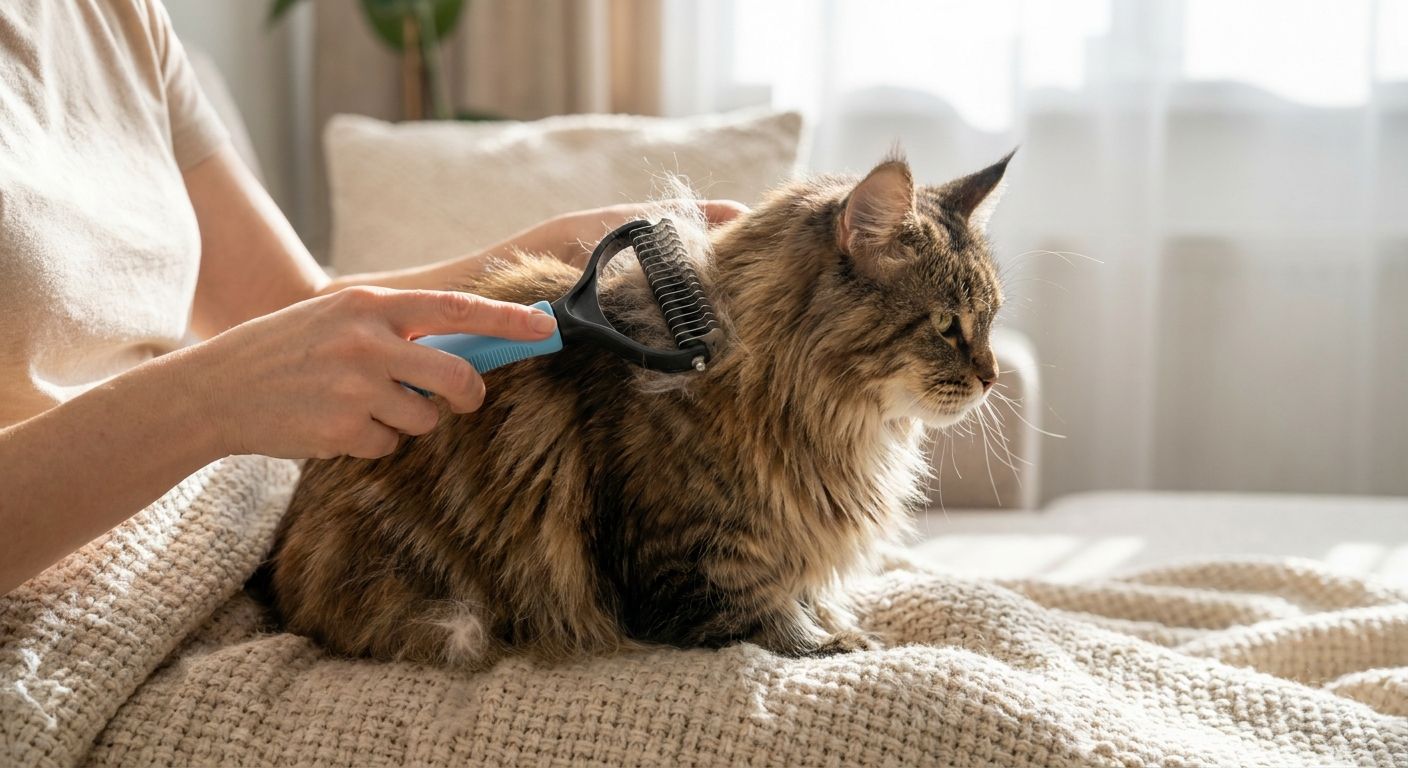
Long-haired cats need a de-shedding session 2 to 3 times a week in normal months, and once a day during peak shedding season, based on standard veterinary grooming guidance for 2026. Skip more than a week and loose undercoat starts matting behind the ears, in the armpits, and along the belly — the spots most pawrents miss until the mat is already tight against the skin.
- Brush a long-haired cat 2-3 times a week in normal months; go daily during spring and fall shedding cycles in 2026.
- Skipping sessions for a week lets loose undercoat mat behind the ears, armpits and belly.
- Sessions run 5-10 minutes each; longer sessions on already-matted coats add stress without removing more hair.
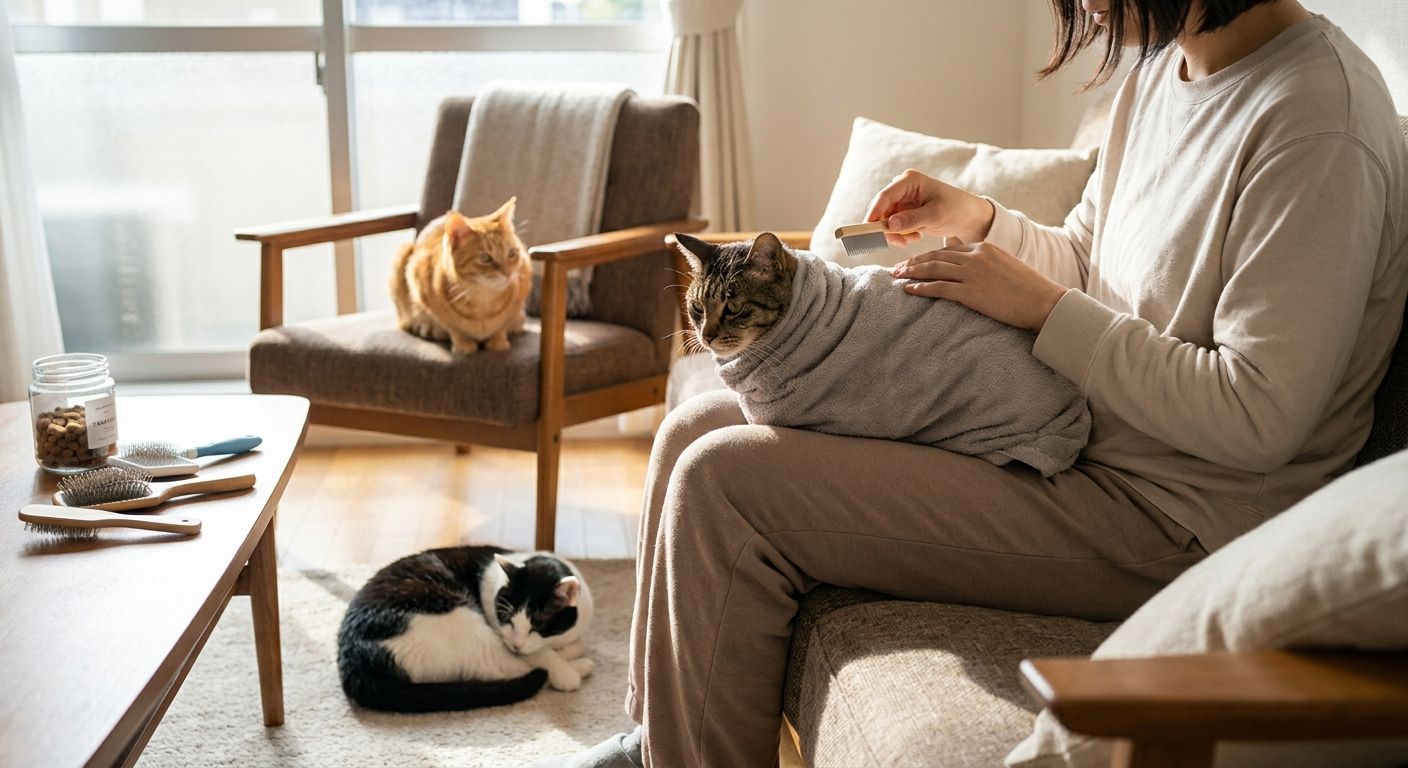
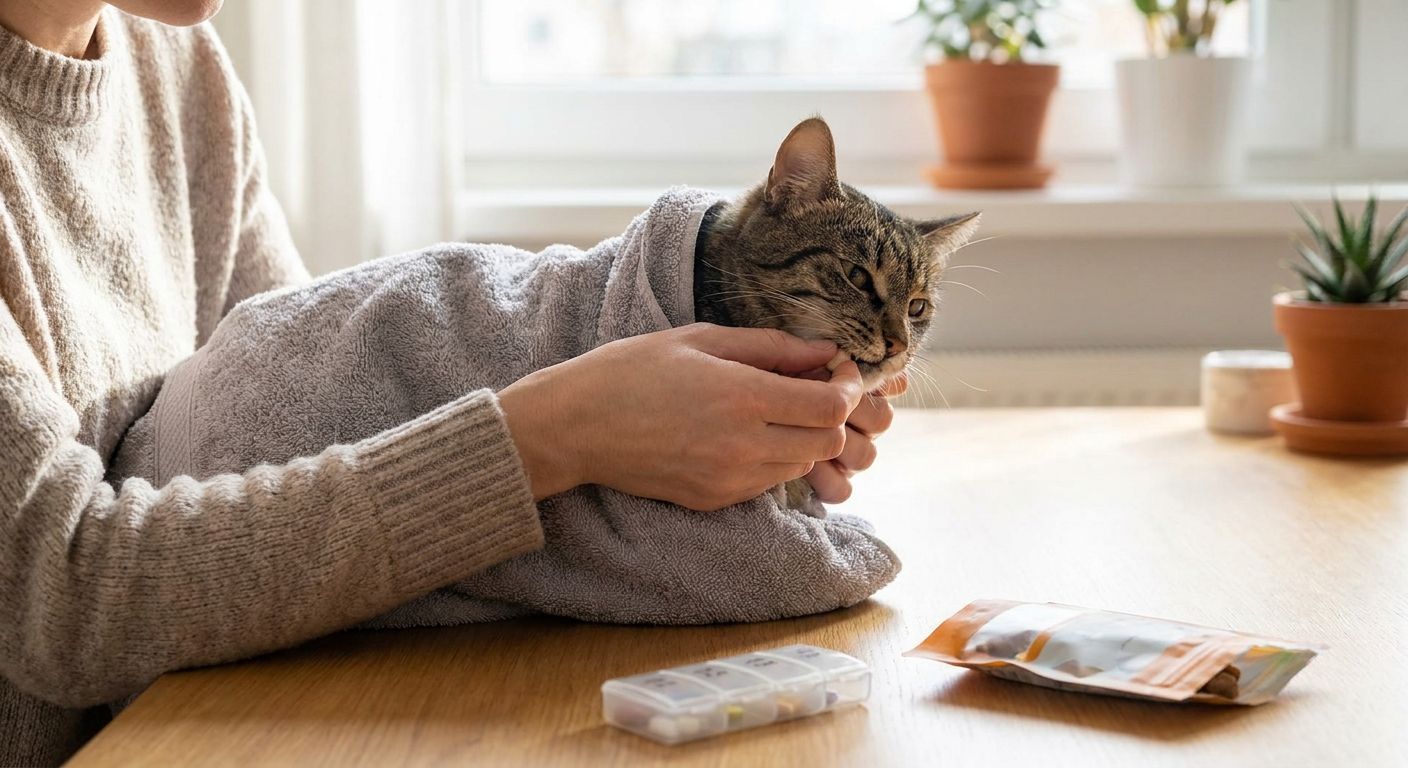
- The Snug Pro Cat Wrap keeps a wriggling cat snug, not tight, through the de-shedding minutes cats fight hardest.
Why this matters
A long-haired cat's undercoat doesn't fall out evenly. It builds up in dense pockets, and once it mats, the fix stops being a brush and starts being scissors or a vet-administered shave under sedation. That's the hidden cost behind the headline frequency number — a missed week doesn't just mean more fur on the couch, it means a harder session next time.
Grooming tools matter here as much as the schedule. The right grooming gloves for long-haired cats pull loose undercoat out in one pass instead of tugging at tangled topcoat, which is why the tool you use changes how often you actually need to sit your cat down for a session.
How often should you de-shed a long-haired cat?
Frequency shifts with the season and the cat's life stage, not a fixed calendar rule. The table below is the fastest way to check where your cat's routine should sit right now.
| Season / Life Stage | De-shedding Frequency | Session Length |
|---|---|---|
| Normal season | 2-3 times a week | 5-10 minutes |
| Peak shedding season (spring & fall) | Once daily | 5-10 minutes |
| Kittens under 6 months | 2-3 times a week, shorter strokes | 3-5 minutes |
| Senior cats (10+ years) | 2-3 times a week, gentle pressure | 5 minutes |
Normal season: 2-3 times a week
Outside of the heavier shedding windows, 2-3 sessions a week is enough to keep a Persian, Ragdoll, or Maine Coon's undercoat from building up. Each session should take 5 to 10 minutes — long enough to work through the flank and belly, short enough that the cat doesn't start associating grooming with a fight.
Cats that get this baseline rarely mat. Cats that get brushed once every two weeks almost always do, because the undercoat has time to felt together before anyone touches it.
Peak shedding season: once daily
During spring and fall shedding cycles, daily de-shedding is the standard recommendation — the volume of loose undercoat coming out in a normal week's worth of brushing can double or triple during this window. Daily sessions in this stretch stay short, 5 to 10 minutes, because you're managing volume, not tackling mats.
Regular de-shedding sessions during this period also cut down on how much loose fur a cat swallows during self-grooming, which is a direct line to fewer hairballs — a connection worth reading in full on how regular grooming affects hairballs.
Kittens and senior cats: 2-3 times a week, shorter sessions
Kittens under six months and senior cats past 10 years both need the same weekly frequency as an adult in normal season, but the session itself should run shorter — 3 to 5 minutes for kittens still learning to tolerate handling, and gentle, low-pressure strokes for seniors with thinner skin or arthritis. Pushing a 10-minute session on either group usually backfires and makes the next session harder to start.
Why de-shedding frequency varies
Not every long-haired cat follows the same clock. These are the factors that actually move the number:
- Coat density and undercoat thickness — Persians, Ragdolls, and Maine Coons carry more undercoat than a domestic long-hair mix and shed more volume per session
- Indoor air-conditioning — in Malaysia, Singapore, and Thailand, year-round AC exposure can trigger steadier shedding instead of the sharp spring/fall peaks seen in temperate climates, since temperature swings from AC vents matter more to a cat's coat cycle than the outdoor tropical climate
- Age and health — thyroid or kidney issues increase shedding volume and can shift a cat's normal schedule closer to daily
- Diet and hydration — a dry, dehydrated coat sheds more and mats faster
- Stress and grooming tolerance — a cat that resists brushing gets groomed less often, and that gap is exactly what lets mats form
- Bathing and wipe-down routine — wipes lift surface debris between sessions but don't replace the undercoat removal a de-shedding tool does
Cats that fight every session and end up skipped are the ones most likely to mat, regardless of coat type. If handling is the real blocker, working through a short desensitization routine changes the outcome faster than buying a better tool — see how long it takes to desensitize a cat to grooming for the timeline.
How long should a de-shedding session take for a long-haired cat?
A de-shedding session should take 5 to 10 minutes, whether it's happening 2-3 times a week or daily during peak shedding season. Sessions longer than that on a matted coat usually mean the tool isn't working through the tangle efficiently, not that the cat needs more time under the brush.
Do long-haired cats in Malaysia and Singapore actually shed less because of the tropical climate?
No — tropical outdoor climate doesn't reduce indoor shedding, because most pet cats in Malaysia, Singapore, and Thailand live in air-conditioned homes, and it's the AC-driven temperature swings and daylight exposure that drive a cat's coat cycle, not the weather outside. A long-haired cat kept in consistent AC can shed steadily through the year instead of following a sharp seasonal spike.
Can regular de-shedding reduce hairballs?
Yes — regular de-shedding reduces the loose undercoat a cat swallows during self-grooming, which is the main source of hairball buildup in long-haired breeds. Cats groomed 2-3 times a week in normal season and daily during shedding peaks typically self-ingest far less loose fur than cats groomed sporadically.
Cats that squirm through the first minute of a de-shedding session usually settle once they're held gently and consistently — that's the gap the Snug Pro Cat Wrap is built to close, keeping a cat snug, not tight, long enough to finish the brush-through instead of abandoning the session halfway.


FAQ
How often should you de-shed a long-haired cat?
De-shed a long-haired cat 2 to 3 times a week in normal months and once a day during peak shedding season in 2026. Sessions run 5 to 10 minutes each.
What happens if you skip de-shedding for a week?
Skipping de-shedding for a week lets loose undercoat build up and mat behind the ears, in the armpits, and along the belly. Once matted, the fix usually needs scissors or a vet shave instead of a brush.
Do kittens need de-shedding?
Kittens under six months need the same 2-3 times a week frequency as adults, but sessions should stay short at 3 to 5 minutes while they build tolerance for handling.
Is daily brushing too much for a cat?
Daily brushing is not too much during peak shedding season, but outside of that window it's usually unnecessary and can wear down a cat's patience for future sessions.
Can regular grooming reduce hairballs in long-haired cats?
Yes, regular grooming reduces hairballs because it removes loose undercoat before a cat swallows it during self-grooming. Cats brushed on schedule ingest far less fur than cats groomed sporadically.
Do cats in air-conditioned homes still have a shedding season?
Yes, cats in air-conditioned homes in Malaysia, Singapore, and Thailand can still shed steadily year-round because AC-driven temperature swings and light exposure drive the coat cycle more than outdoor tropical weather does.
What's the best way to hold a squirmy cat still for de-shedding?
A wrap that holds a cat snug without restricting movement works better than physical restraint alone, since a calmer cat sits through a full 5 to 10 minute session instead of fighting halfway through.
One last thing
The biggest miss in most long-haired cat routines isn't frequency — it's assuming shedding season ends when the calendar says fall is over. In air-conditioned homes across Malaysia and Singapore, the coat cycle runs on indoor temperature swings, not the tropical weather outside, so a cat can keep shedding at a near-daily pace well past the point most pawrents switch back to a twice-a-week routine in 2026. Watch the fur on the floor, not the date, and adjust the schedule from there.