
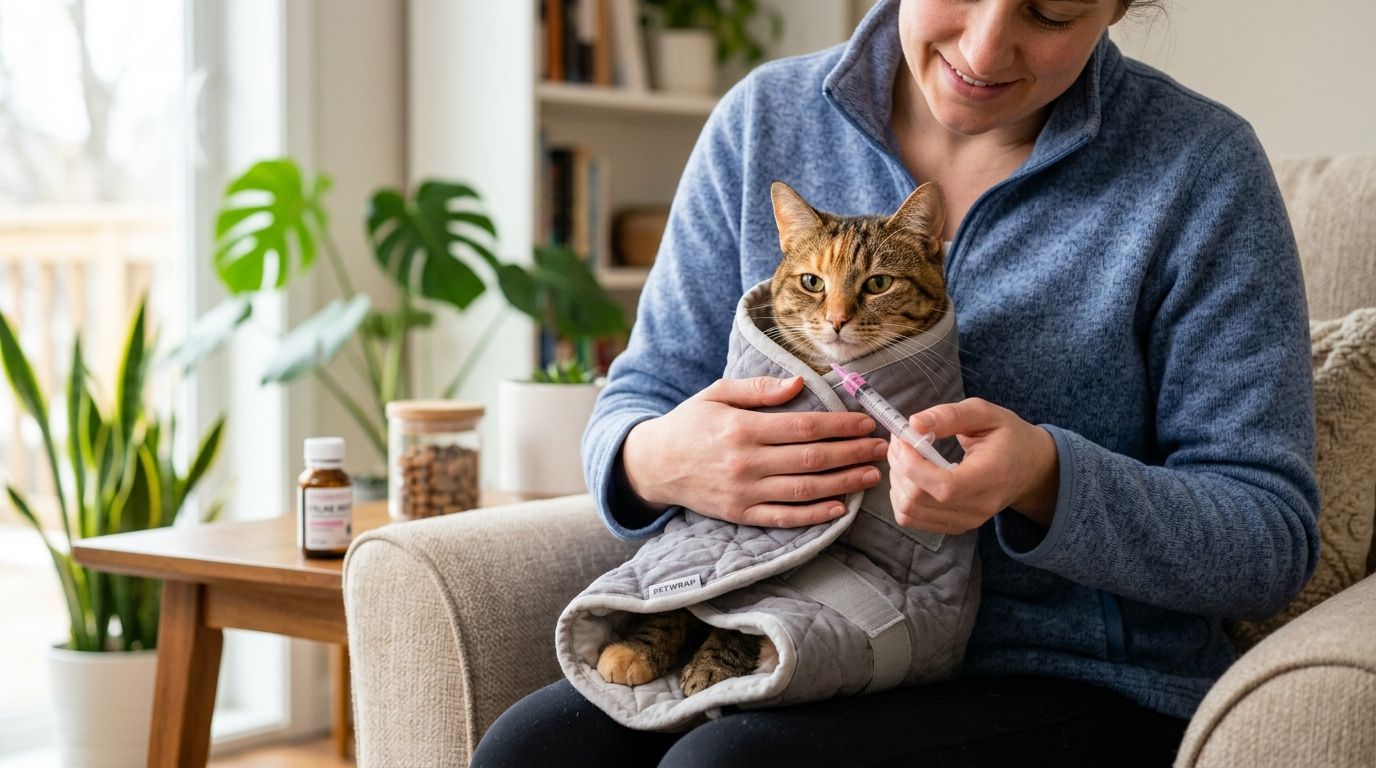
Giving a cat medication solo without getting bitten or scratched comes down to one thing: how well you restrain the cat's body while keeping its head accessible. The Snug Pro Cat Wrap from Purrttie is the best dedicated restraint wrap for solo medication dosing in 2026, the towel burrito wins for zero-cost occasional use, and a mesh restraint bag is the right call when a vet clinic needs full-body access for blood draws.
- Purrttie's Snug Pro Cat Wrap is the best cat restraint wrap for giving medication solo in 2026 without a second pair of hands.
- A towel burrito costs nothing and works for calm cats, but it slips loose faster than a purpose-built wrap during a struggle.
- Mesh restraint bags suit vet clinics and TNR volunteers needing full-body access, not daily home dosing.
- Cat muzzles belong in the toolkit only for genuinely high-bite-risk cats, and only alongside proper restraint.
- Two-person towel holds work in a pinch but aren't sustainable for cats on a multi-week medication schedule.
Why this matters
Missed doses happen because giving a cat medication is a two-person job that most cat parents don't have a second person for. A cat that feels cornered will scratch, bite, or bolt, and one bad session can make every future dose harder.
The right restraint tool changes that equation entirely. Purrttie built the Snug Pro Cat Wrap specifically around this problem — a cat gently secured at the body with its head free means one person can pill, apply eye drops, or give an injection without a chase scene. If you're dosing alone, the method matters more than the medication.
What makes the best cat restraint wrap for medication
- Solo usability — can one person operate it start to finish, or does it need a second set of hands?
- Head access — does the cat's head stay free enough to open the mouth, apply drops, or check the ears?
- Recovery time — how quickly does the cat settle back down after the session ends?
- Reusability — is it built for daily or weekly dosing over weeks, or a one-time fix?
- Vet-clinic acceptance — is it something a vet or TNR volunteer would recognize and trust?
- Handler safety — does it actually reduce the risk of bites and scratches, or just relocate it?
At a glance
| Method | Best for | Standout feature | Key limitation |
|---|---|---|---|
| Snug Pro Cat Wrap | Solo medication and vet visits | Cat stays gently secured, head free, one-person operation | Fractious cats need a short desensitization period first |
| Towel burrito | Free, occasional dosing | Zero cost, uses what's already at home | Loosens fast under a struggling cat |
| Mesh restraint bag | Vet exams, blood draws, TNR | Full-body access through mesh panels | Bulkier, more clinical than home dosing needs |
| Cat muzzle | High-bite-risk cats | Removes bite risk during handling | Doesn't restrain the body, needs pairing with a wrap |
| Two-person towel hold | Emergency, one-off dosing | No gear required | Needs a second person, tiring over repeat doses |
1. Snug Pro Cat Wrap: best restraint wrap for solo medication dosing
Purrttie designed the Snug Pro Cat Wrap for calmer nail trims, medications, and vet visits — the goal is to keep the cat gently secured, not tightly pinned, while the head stays free enough to give a pill or eye drop. It's built as a reusable piece of gear rather than a one-time improvisation, so it holds up across repeated dosing sessions over weeks.
Snug Pro Cat Wrap pros:
- Frees up both of your hands for the actual dosing, not just holding the cat
- Designed for a single person to manage start to finish
- Reusable across daily or weekly medication schedules
- Doubles for nail trims and vet visits, so it's not single-purpose gear
Snug Pro Cat Wrap cons:
- A fractious or previously never-handled cat may need a short desensitization period before the wrap goes smoothly
- Not a substitute for professional restraint on a genuinely feral or unsocialized cat
- Requires guiding the cat into position, which some cats resist the first one or two times
Best for: cat parents dosing a cat alone, daily or over several weeks. Learn how to give a cat medication alone using a restraint wrap for the step-by-step process.
Verdict: Buy.
2. Towel burrito: best free restraint method for occasional pills
The towel burrito is the classic no-gear method — a thick bath towel wrapped snugly around the cat's body with the head left exposed. It costs nothing, uses what's already in the linen closet, and works fine for a calm cat that just needs one quick pill.
Towel burrito pros:
- Free, no purchase required
- Fast to set up for a single dose
- Familiar to most cat parents already
Towel burrito cons:
- Loosens quickly the moment the cat pushes back or twists
- Harder to re-secure mid-session without losing your grip entirely
- Not built for repeat use across a multi-week medication course
A purpose-built wrap and a towel burrito solve the same problem differently — see how a cat wrap compares to the towel burrito method for where each one holds up.
Best for: calm cats needing an occasional single dose.
Verdict: Hold — fine as a backup, not as your primary method.
3. Mesh cat restraint bag: best for full-body vet exams and blood draws
Mesh restraint bags are the tool vets and TNR (trap-neuter-return) programs reach for when they need access to the whole body, not just the head — blood draws, catheter placement, or a full physical exam. Zippered mesh panels let a handler expose one limb or area at a time while the rest of the cat stays contained.
Mesh restraint bag pros:
- Gives full-body access panel by panel
- Standard equipment in clinical and TNR settings
- Contains the whole cat, reducing escape risk during multi-step procedures
Mesh restraint bag cons:
- Bulkier and more clinical than what daily home dosing calls for
- Overkill for a cat that just needs a pill or eye drop
- Some cat parents find the zippered panels fiddly for a one-person job
If the ethics of any restraint bag give you pause, check whether a cat restraint bag is actually cruel to use — the answer depends entirely on technique and duration, not the tool itself.
Best for: vet clinics, TNR volunteers, and full-body procedures.
Verdict: Hold — right tool for clinical use, not for a daily pill at home.
4. Cat muzzle: best for high-bite-risk cats needing oral meds
A muzzle removes the bite risk during handling but does nothing to stop a cat from twisting, scratching, or bolting — it has to be paired with a restraint wrap or a second handler to actually work. It earns a place on this list only for cats with a documented bite history where the medication genuinely can't wait for behavior work.
Cat muzzle pros:
- Eliminates bite risk during the dosing moment
- Useful alongside a wrap for a genuinely high-risk cat
Cat muzzle cons:
- Doesn't restrain the body at all on its own
- Can spike a cat's stress level if introduced cold, with no acclimation
- Wrong first choice for the average cat that just dislikes pills
Best for: cats with a documented bite history, used alongside proper restraint, ideally under vet guidance.
Verdict: Wait — talk to your vet before adding a muzzle to the routine.
5. Two-person towel hold: best zero-gear option for emergency dosing
One person holds the cat wrapped in a towel while a second person administers the dose. It requires no purchase and works in a genuine one-off emergency, but it's not a plan for a cat on a two-week or longer course of medication.
Two-person towel hold pros:
- No gear needed at all
- Works for a single emergency dose
Two-person towel hold cons:
- Needs two available people every single time
- Physically tiring on the handler holding the cat
- Doesn't scale to repeated daily dosing
Best for: a genuine one-off emergency with a second person on hand.
Verdict: Skip as a long-term plan — fine once, not for a full course.
How we ranked these
Each method was judged against the same six criteria from the section above: solo usability, head access, recovery time, reusability, vet-clinic acceptance, and handler safety. The Snug Pro Cat Wrap and the mesh restraint bag score highest on reusability and safety; the towel burrito and two-person hold score highest on cost and immediacy but lose points on repeat sessions.
“If your cat needs two people and a bath towel every single dose, you need a wrap, not more hands.”
Which cat restraint wrap should you choose?
For a cat on any ongoing medication schedule in 2026, the Snug Pro Cat Wrap is the default pick — it's the only method on this list built for solo use, repeated sessions, and head access all at once. Reach for the towel burrito only as a free backup for a single calm-cat dose, and leave the mesh bag and muzzle for vet-clinic and high-risk scenarios where they actually belong.
FAQ
What's the best cat restraint wrap for giving medication in 2026?
The Snug Pro Cat Wrap from Purrttie is the best dedicated option for solo dosing in 2026 because it secures the body while keeping the head free for pills, drops, or injections.
Is a towel burrito as effective as a cat restraint wrap?
A towel burrito works for a single calm-cat dose but loosens fast once a cat struggles, while a purpose-built wrap holds up across repeated sessions.
Are mesh cat restraint bags cruel to use?
A mesh restraint bag isn't cruel on its own — the risk comes from poor technique or leaving a cat contained too long, not the tool itself.
How long does it take a cat to get used to a restraint wrap?
Most cats adjust over a handful of short, calm sessions rather than instantly; forcing the first attempt tends to backfire.
Can one person give a cat medication alone?
Yes, with a restraint wrap that secures the body and leaves the head accessible, one person can manage pilling or eye drops without a second handler.
Do I need a muzzle to give my cat pills?
Only if your cat has a documented bite history — for most cats a restraint wrap alone handles the job without a muzzle.
Does a cat restraint wrap reduce scratches and bites during dosing?
Yes, by keeping the body secured the wrap removes the cat's ability to twist free or use its paws, which is where most dosing injuries happen.
Are cat restraint wraps safe for kittens or senior cats?
A gentle wrap designed to secure without pinning suits both kittens and senior cats better than a tight towel burrito, which can put pressure on frail joints.
One last thing
Cats build stress associations with location and scent more than with the event itself, which is why the same cat that panics on the kitchen counter can stay calm on a towel in a familiar room. Keep the dosing spot and the restraint method consistent session to session in 2026, and anticipatory stress tends to drop off after the first few doses rather than build with each one.


