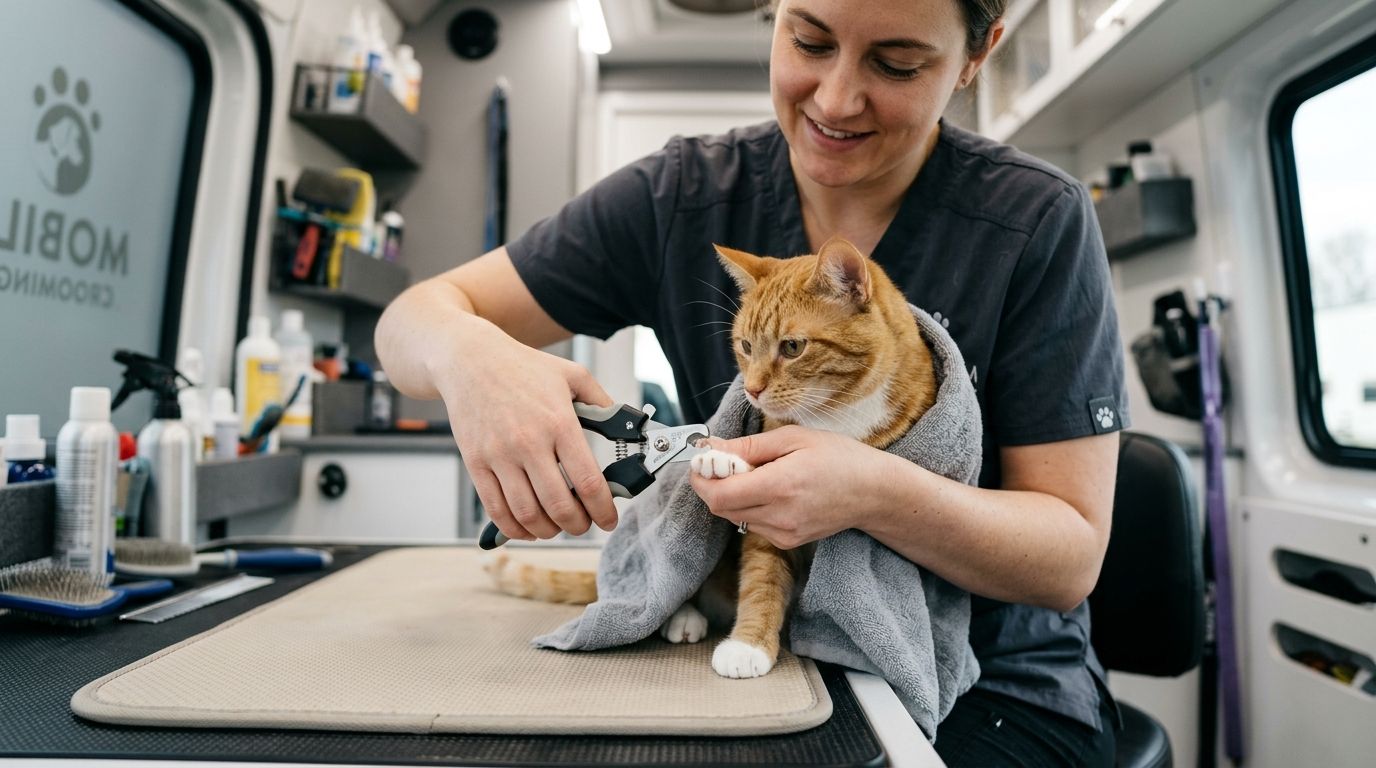
Cat nail clippers for mobile groomers need to work one-handed, in low light, inside a moving van, on a cat that's never met you before today. The segment's constraint isn't preference, it's logistics: no second set of hands, no fixed grooming table, and a tight slot between appointments to disinfect and reset.
- Cat nail clippers for mobile groomers need a one-handed grip, a wide-view blade, and fast sanitizing between visits.
- Purrttie's Full Stainless Steel Cat Nail Clipper cuts in one snip and suits back-to-back van appointments. Buy it.
- Guillotine-style clippers slow down fractious-cat trims; scissor-style stainless steel clippers give steadier one-handed control.
- Pair clippers with a restraint tool for solo appointments where no one is holding the cat for you.
Why cat nail clippers matter for mobile pet groomers
A mobile groomer doesn't get a second attempt at building trust with a cat mid-route. If the first nail trim goes badly in someone's living room, the client cancels the next visit and tells other cat owners why.
The clipper itself decides a lot of that outcome. A blade that requires repositioning mid-cut, or a handle that needs both hands to squeeze closed, turns a 20-second trim into a 3-minute wrestling match with an already-nervous cat. Purrttie builds grooming tools specifically around that single-handed, fast-and-calm use case, which is why mobile groomers keep showing up in the buyer mix for its nail clippers.
Choose the right blade design for van-based work
Start with the blade geometry before anything else. Guillotine-style clippers force the nail through a small hole, which is slower to line up on a cat that's shifting its paw in your lap.
- Pick a scissor-style, spring-loaded clipper for faster repositioning between nails
- Choose a wide-view blade opening (18mm or wider) so you can see the quick before you cut
- Avoid clippers with a narrow sightline if you groom cats with dark or pigmented nails
- Test the spring tension with gloves on, since you'll often work in a cold van in the morning
- Check that the blade is a single piece of stainless steel, not two riveted halves that loosen with repeated sanitizing
Test grip and one-handed control before you buy
A clipper that needs a firm two-handed squeeze isn't built for mobile work, where your other hand is usually stabilizing the cat's paw or scruff. Hold the clipper the way you would mid-trim, not the way it sits in a display photo.
- Hold the clipper closed for 10 seconds and check for hand fatigue
- Confirm the handle spread fits your hand size without repositioning your grip mid-cut
- Look for a non-slip handle coating, since hands get damp during a busy 2026 route
- Rule out clippers where the safety guard blocks your view of the nail
If you're resetting your grip mid-trim, the clipper doesn't fit your hand and it's costing you seconds on every single cat.
Build a two-tool safety kit for solo appointments
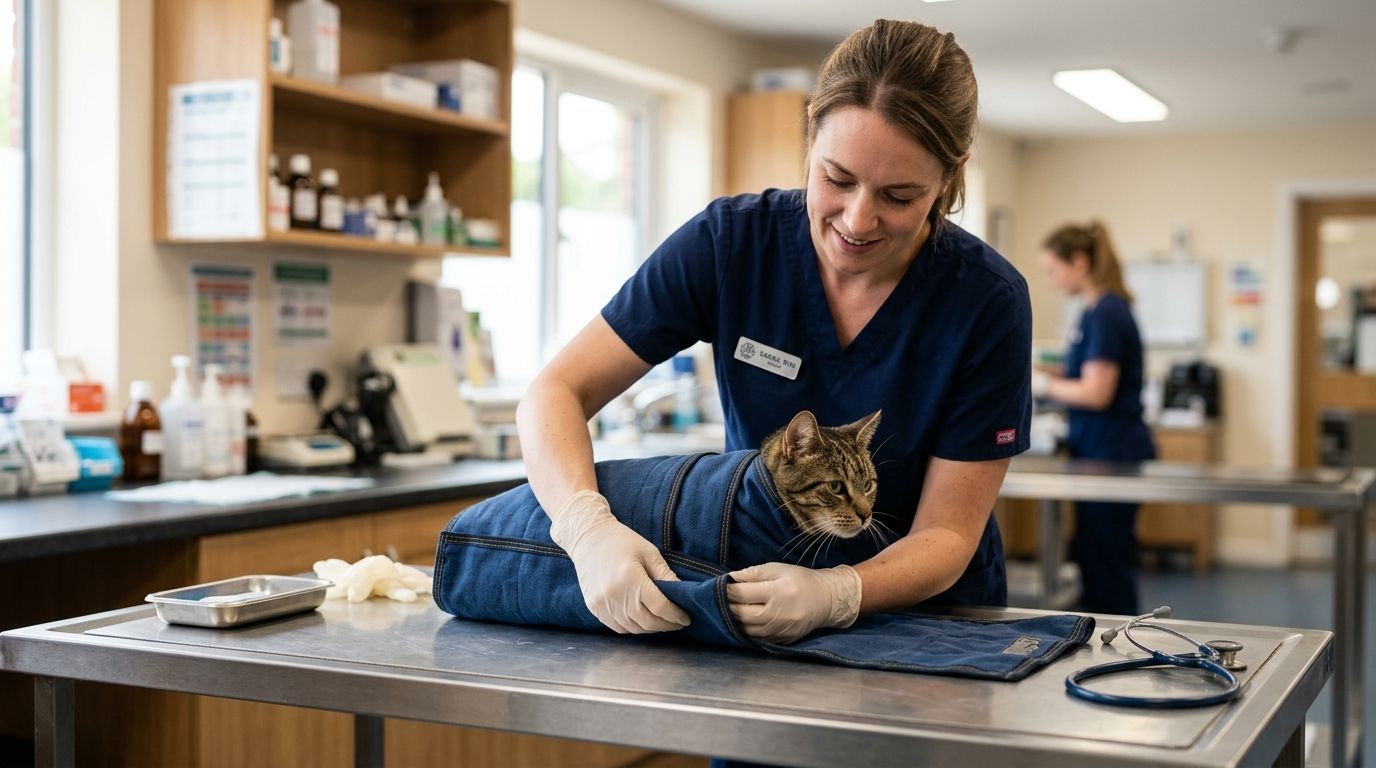
Most mobile groomers work without an assistant, which means the cat has to be both restrained and trimmed by the same person. A clipper alone doesn't solve that problem; you need a restraint method that keeps the cat calm without a second set of hands.
- Keep a lightweight restraint wrap in the van for cats that won't sit still on a towel
- Practice the wrap-and-trim sequence at home before using it on a client's cat
- Use a wrap that lets the cat's head stay free, since full-body pressure spikes stress in most cats
- Skip full-body towel burritos for arthritic or senior cats, where joint pressure causes pain, not calm
The Snug Pro Cat Wrap is built for exactly this solo scenario, keeping the cat snug without the chase so you can trim nails, give medication, or prep for a vet referral without a client hovering to help.
Set a sanitizing routine between appointments
A clipper that touched one client's cat and then goes straight into the next carrier is a fast way to spread ringworm or bacterial infections across your route. Build the reset into your schedule, not as an afterthought.
- Wipe blades with a veterinary-grade disinfectant between every single appointment, not just at the end of the day
- Dry the blade fully before folding it away, since trapped moisture pits stainless steel over months of daily use
- Carry two clippers on longer routes so one can air-dry while the other works
- Inspect the spring hinge weekly for rust, which slows the snap and dulls precision faster than the blade edge does
Price and time your nail-trim add-on for 2026
Mobile groomers who bundle nail trims into a full groom lose money if the trim runs long. Time the task honestly before you set your schedule for 2026.
- Budget 5-10 minutes for a calm cat, 15-20 for a first-time or fractious cat
- Build a buffer slot after any cat flagged as anxious on intake notes
- Offer nail trims as a standalone add-on for clients who only want that service
- Track which cats need extra time so future bookings account for it automatically
Train for the fractious or fearful cat
Every mobile groomer eventually meets a cat that won't tolerate a trim no matter how good the clipper is. The fix isn't a stronger grip, it's a slower approach and the right stopping point.
- Trim one or two nails per session on a highly stressed cat rather than forcing all ten
- Watch for tail flicking and ear rotation as your stop signal, not just hissing or biting
- Reschedule rather than restrain harder when a cat escalates past mild resistance
- Note the trigger (nail file sound, specific paw, being lifted) in client records for next time
Track blade wear and replace on schedule
A dull blade doesn't just cut slower, it crushes the nail before it cuts, which causes splitting and pain even on a calm cat. Mobile groomers run more trims per week than home users, so blades wear faster.
- Replace or resharpen blades after heavy use, well before you notice visible dulling
- Listen for the cut sound changing from a clean snip to a crunch
- Keep a spare clipper in rotation so a dulling blade never delays a booked appointment
- Log purchase dates so you're not guessing how old each clipper is
Comparison: clipper options for mobile groomers
| Option | Best for | Key limitation |
|---|---|---|
| Scissor-style stainless steel clipper | Fast, one-handed trims across back-to-back appointments | Needs regular sanitizing and periodic blade replacement |
| Guillotine-style clipper | Groomers already trained on this style for years | Slower to reposition on a shifting paw |
| Nail grinder | Cats that tolerate sustained handling and noise | Louder motor spooks fearful cats mid-route; needs a power source |
| Basic scissor trimmer (non-stainless) | Occasional home use, not commercial routes | Dulls faster under daily mobile-grooming volume |
The Full Stainless Steel Cat Nail Clipper sits in the first row: cut from a single piece of steel with an 18mm wide-view blade, built for the one-snip, no-squeeze trim that a moving schedule demands.


Common mistakes mobile groomers make
- Skipping a restraint tool to save van space. A wrap takes up less room than a second cancelled booking.
- Clipping in poor lighting inside the vehicle. A wide-view blade only helps if you can actually see the quick.
- Reusing the same clipper across clients without drying it fully. Trapped moisture and cross-client bacteria both travel faster than groomers expect.
- Overbooking nail trims back-to-back with no buffer for anxious cats. One fractious cat pushes every later appointment late.
- Ignoring blade wear until nails start splitting. By then the cat has already associated the trim with pain.
FAQ
What are the best cat nail clippers for mobile groomers in 2026?
Scissor-style stainless steel clippers with a wide-view blade, like Purrttie's Full Stainless Steel Cat Nail Clipper, work best for mobile groomers in 2026 because they cut in one motion and don't need a firm two-handed squeeze. Guillotine styles are slower to reposition on a moving paw inside a van.
Do mobile groomers need a restraint tool in addition to clippers?
Yes, most mobile groomers work solo without an assistant holding the cat. A lightweight restraint wrap lets one person stabilize and trim at the same time, which a clipper alone can't solve.
How often should a mobile groomer sanitize nail clippers?
Wipe blades with a veterinary-grade disinfectant between every appointment, not just at the end of the route. Cross-client bacteria and fungal spores spread through carriers and blades faster on a tight multi-stop schedule.
Is a nail grinder better than clippers for mobile grooming?
A grinder works for cats that tolerate sustained handling and motor noise, but the noise itself spooks fearful cats more than a quick clip. Clippers are generally the faster, calmer option for a full mobile route.
How long should a nail trim take on a mobile grooming visit?
Budget 5 to 10 minutes for a calm cat and 15 to 20 minutes for a first-time or fractious cat in 2026 scheduling. Building that buffer in prevents one difficult cat from delaying every later appointment.
What blade width is best for cats with dark nails?
An 18mm or wider blade opening gives a clearer sightline to the quick on pigmented nails. Narrow-view clippers make it harder to judge the cut line, which raises the risk of a bleed on dark nails specifically.
Can one clipper handle a full day of mobile appointments?
A single-piece stainless steel blade holds an edge through a full day better than riveted two-piece blades, but heavy mobile use still wears blades faster than home use. Rotating two clippers avoids a mid-route dulling problem.
One last thing
The detail that separates a smooth mobile nail trim from a fight isn't the blade brand, it's whether the cat's head stays free during restraint. Full-body pressure spikes stress in most cats, while a wrap that leaves the head loose keeps them calmer through the entire trim, medication dose, or vet-visit prep in 2026 and beyond.